Tuesday, July 11, 2006

Modern Romance, Bad Company, Seven Brides for Seven Brothers, Candy with Strangers
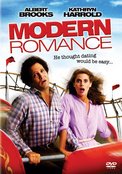
I haven't seen many Albert Brooks films. I've seen many more Woody Allen movies, though my current opinion of Woody is pretty low. They cover similar turf, but Allen is much more prolific (imdb lists over 40 films he's directed, while Brooks has directed only 7 features). I enjoyed The Muse and Mother, but I wasn't prepared for how great Modern Romance would be. The movie opens as Albert Brooks decides to break up with his girlfriend--beginning with a breakup? I can't remember another movie I've seen that does that. For the first half of the film, in something close to real time, it follows his character through that first rough twenty four hours after he's made this decision in a sequence of sustained brilliant comedy. It becomes slightly more conventional after that, interweaving a humours subplot about Brooks' job (he's a film editor in L.A.) that is arguably unrelated to the main plot but offers welcome comedic diversity. I was impressed with the way the film captures the problems of romance in a world where breaking up or divorcing is as easy as getting together or marrying. The couple in this film have no kids, no joint property, nothing formally committing them to one another--a wonderful freedom that has the potential for great neurosis. This being comedy, it's very exaggerated, but it's also very relevant. Brooks' character borders on the menacing and abusive, prone to jealousy and possessiveness. It gets ugly at times, the kind of dark, painful comedy that I associate with Ben Stiller nowadays.
Rating: 3 ½ out of 4 stars.
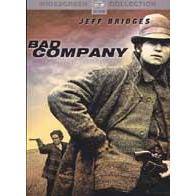

My esteem for Jeff Bridges' career has been growing steadily over the years, so when I read that a trio of well-regarded movies he made in his youth had hit DVD, I took note. Bad Company is the first I've checked out, and it's excellent. I saw it labelled as a Western, but I think it's really better described as a historical coming-of-age story. Or perhaps a gangster picture. Highly episodic in structure, the film follows Drew Dixon (Barry Brown) as he flees service in the Civil War to find freedom and solace out West. Along the way he more or less falls in with a gang of outlaws headed up by Bridges as Jake Rumsey. The storyline is somewhat shocking by today's standards, with cruelty towards animals, vulgar sexuality, and some truly nasty violence. At one point, someone says, "Boy, I'd like to get my hands on that son of a bitch who told me to go west." The story cleverly juxtaposes two main characters of different class/moral backgrounds and seems to ask, Which young man has more integrity when times are tough? And they are desperately tough in this late Civil War era (think the worst moments of Cold Mountain). I'm not a huge fan of the gritty 70s Hollywood which is so often celebrated (Chinatown, Godfather, early Scorsese--not really my thing, though I respect them), but this 1972 film made me appreciate the relative freedom and independence of filmmaking of the time. The often-useless Pauline Kael kvetches about the cinematography of the film, but what may have been cliche in its day looks great now. I only wish the sound quality of the DVD were a bit better.
Rating: 3 ½ out of 4 stars.

Watched Seven Brides for Seven Brothers for the first time, and it was enjoyable. It addresses a kind of Neanderthal male point of view of women and in that respect reminded me of Kiss Me, Kate (which I've not seen but was made the year before with the same lead, Howard Keel) and My Fair Lady, made a decade later. The joke about the Sobbin'/Sabine women is typcial of its sensibility. I had no idea the film was so rambunctious, with knockout athletic dancing and the atmosphere of a Western. I also didn't know the brothers were redheads! (Some natural, some--like the adorable Russ Tamblyn--clearly not.) Jeff Richards was particularly appealling, as was Julie Newmar (then Newmeyer). A macho but enjoyable Hollywood musical.
Rating: 3 out of 4 stars.

Sometimes I'm in the mood for a broad, silly comedy. I want distraction. In such a mood, I'm willing to turn off my brain to get the yuk factor, but I'd prefer not to. Strangers with Candy probably isn't worth many repeat viewings, but it did make me roar with laughter. There are enough background jokes (check out Stephen Colbert as the teacher's blackboard and bulletin board) and verbal jokes (variations on Megawatti's name) mixed in with the sight gags, off-color humor and, of course, Amy Sedaris' aggressive, unabashed mugging for the camera to keep me distracted. I'm not saying it's brilliant. It's more like stupid sketch comedy done by people much smarter than the SNL team. High praise? Certainly not, but not the kind to damn it with either. One warning, though: I've been imitating Jerri Blank's face for days now. It's involuntary.
Rating: 2 out of 4 stars.

*

  • Good review for "The Oh in Ohio," upcoming sex comedy with Parker Posey and Paul Rudd

  • Critic Armond White (who seems to be laying off the crazy pills lately) loves Changing Times, the new Techine film I can't wait for. He also says 2006 is shaping up as a banner year for smaller films. I'm not so sure. I see the potential for that to be true, esp. if you live in New York. But Chicago is still waiting for many of the acclaimed films to screen in town. I hope they don't all hit at once, in the busy October/November film season.

  • In other news, DeepDiscountDVD.com is having a sale on Kino DVDs: 50% off. Yowsah! Time for me to buy that Buster Keaton set at last? Some real gems in this sale--including DVDs so new (like Iron Island) that they haven't even been released yet.

  • One of my favorite writers, Michael Bronski, recently wrote about how Leonardo da Vinci's work really is coded, with gay meaning. He also co-interviewed Bernard Baran, finally free after years of wrongful imprisonment.

  • A tidbit: I never knew Otto Preminger had a brother--named Ingo!--let alone that he was a lawyer who defended blacklisted talent.

Labels: ,

Tuesday, May 09, 2006


This Week's Movies

For fun I rented Sherlock Holmes and the Case of the Silk Stocking, a recent Masterpiece Theatre production. Impressive production values (MT's come a long way!) and a high-quality cast, but unfortunately Allan Cubitt's script could have been better. The story was very much in the vein of CSI / Silence of the Lambs, to the point of cliche. Think serial killer. Think a signature object left inside the victims' throats. Imagine Holmes and Watson discovering they have the wrong man and having to race to find the culprit before the latest victim (who they used as bait) expires. Not exactly a nail biter. More importantly, I have to get this off my chest: it takes more to satisfy Holmes fans than just ticking items off a checklist of Holmesiana: a reference to his drug use (ok), got him reading a book about bees (yup), reference to his sexuality/problem with women (got it), playing violin (mm hmm). Thing is, you've got to do something meaningful with these ideas.

Still, Cubitt and director Simon Cellan Jones wisely follows in the mold of Billy Wilder's The Private Life of Sherlock Holmes. The two characters are portrayed at a point after Watson has moved out of the bachelor's quarters of 221B Baker Street. Watson is concerned as friend and doctor by Holmes' drug use. Watson is pursuing romance, Holmes isn't. (In fact, in this story, Watson's on the cusp of marriage.) There's also the enjoyable feeling of excitement that they get to work together again--a feeling that taps into our longing to resurrect the duo for further adventures. Best yet, Rupert Everett is a natural choice to play Holmes--he's physically perfect for the part, with his height and his prominent nose and chin, not to mention the aristocratic demeanor that can give him a chilly and effortlessly superior air (a quality he got to do even more with in Separate Lies). If you can overlook the opening pose he's directed to give, the performance is quite good. Ian Watson is also a grand Watson, the best I've seen yet of the few I've sampled so far. Helps that he's an unusally good and criminally underrated actor. His Watson is a friend of perhaps greater common sense than Holmes and, here's the key: less intelligence than Holmes but not less intelligence than the average man.

It breaks the illusion of time-travel you get from reading Conan Doyle, but in a way I enjoyed seeing Watson's fiancee, a bold and modern American woman psychiatrist, expose Holmes to Kraft-Ebbing, though of course with the modern serial killer angle thrown in it degenerates into an excuse for a kinky killer. I get it. Out with the Victorian world, in with our modern world. It's the lesson of way too many Holmes pastiches--but is our world so much less interesting than Conan Doyle's? I don't expect the thrill of exploring the Victorian mentality I get from Conan Doyle, but can't I be thrilled by exploring the Edwardian era? It's still pretty long ago--a century. Rating: 2 out of 4 stars.

Also watched David Lean's masterful Brief Encounter. Trevor Howard is excellent and Celia Johnson is outstanding as two married people who cross paths, fall in love, and struggle with what to do about it. At the end I asked Red if he thought she made the right decision, and it turned out we'd just watched two completely different movies. He saw Alec as predatory and I saw him as hesitantly seductive (for once the Adam and Eve roles are reversed). Only fully-dimensional characters can lead to such a satisfying disagreement and discussion. I was impressed with the cinematography (and what a sparkling clean-up job Criterion did) and the way Laura's narration comes across so dreamily and fluidly. (Spoilers ahead.) It's one of those movies that captures a lifetime in 86 minutes--birth, prime and death...of a love affair, of a potential life. After seeing it can you ever forget the full-circle impact of that chatterbox's interruption? The spaces and rhythms of the story works so well: those Thursday rituals, the movie matinees (with Donald Duck and B-Movie Tarzans), the lady cellist, the tea room rendezvous, the trains in opposite directions. I enjoyed and admired the comical counterpoint involving the guard and the tea room matron. And I'll confess a weakness for the Rachmaninoff. It's poured on shamelessly thick, but that's the way I like old b&w romantic stories. I've seen a few I've liked slightly better--this story was just a bit thin for my taste, needing perhaps just another episode for thickness, but it was time well spent. Rating: 4 out of 4 stars.

Continuing my interest in Preminger and in Dana Andrews, we also watched the new-to-DVD Fallen Angel, a noir that I'd rank far behind Where the Sidewalk Ends and Laura. Andrews seems a bit tired playing a fairly despicable con man. Linda Darnell is strong as a femme fatale and Alice Faye actually refreshing as the goody-goody who stands by her man when he's suspected of foul play, deserving of punishment if not quite guilty. Percy Kilbride (who I've enjoyed quite a bit recently in State Fair and Keeper of the Flame) and Charles Bickford (as a troubled cop from the East) have supporting parts that are somewhat less than satisfying. It's yet another noir story that sees California as part-Wild West and part end-of-the-line, a place you end up when you've been on the run (with a very similar set-up as the much worse The Postman Always Rings Twice--man gets to California looking for a new life and walks into a little diner). The film is competent, but overlong (actually made me sleepy at times). Not recommended. Rating: 1 ½ out of 4 stars.

Miscellaneous

You know how they do those sing-along showings of movies like The Sound of Music? In some places they've done them for "Once More with Feeling," the musical episode of Buffy the Vampire Slayer.

Chicago Reader movie critic Jonathan Rosenbaum is one of the writers and creative types I keep an eye on as I follow the news online. He's been a bit off his game lately, but he's still one of the world's finest, in my opinion, and not only do I follow his work, but I also follow what others are saying abou him. Here are some tidbits collected since the beginning of the year.

Early in the year I noticed a swipe from critic Scott Renshaw, holding up Mr. Rosenbaum as a humorless symbol of anti-commercial views (and, worse, lumping him together with nutcake provocateur Armond White). It's a common complaint about JR, but it just goes to show Renshaw must not read the unfashionable one's reviews, because Rosenbaum regularly sees and recommends contemporary Hollywood fare (sometimes really bad stuff, like Prime). Truth is, JR has his weaknesses and guilty pleasures just like the rest of us.

More recently, Rosenbaum has gotten a lot of mentions (like here, here and here) for his contributions as a Welles expert to the Criterion edition of Mr. Arkadin. I look forward to seeing this movie and listening to his commentary.

In an article on Art School Confidential, Paste Magazine recently mentioned that he once compared Rear Window to comic strips, which is a nifty little insight.

Mr. Rosenbaum is a member of the National Society of Film Critics and serves on many international film juries, including, recently, the Jeonju International Film Festival in Korea.

Critic Andrew Sarris, who I also try to keep up with, apparently is a big fan of The Ballad of Cable Hogue, which was recently issued on DVD.

Song: "God knows(you gotta give to get)" by El Perro del Mar

Labels: ,

Thursday, February 23, 2006

Where the Sidewalk Ends

I've been having my own little Otto Preminger film series on DVD over the last several months. In a college survey course (long ago) we were taught that Preminger helped sweep away the remains of the puritanical Production Code and were shown clips of films like Carmen Jones. That planted a seed of interest for me. Over the years I saw and enjoyed Laura, Bonjour Tristesse, Anatomy of a Murder and Bunny Lake is Missing on the big screen. And last year, during the first Bush Supreme Court nomination, Frank Rich wrote about the DVD release of Advise & Consent, and Fox started releasing its noir box sets, which included Whirlpool. A series was inspired. Unfortunately I was disappointed by the latter two films (esp. Whirlpool), as I also was by River of No Return, a so-so Marilyn Monroe picture. Carmen Jones proved to be somewhat better--Dandridge and Belafonte are certainly good, as is Pearl Bailey, and there's a great little jazzy number about taking the train to the great city of Chicago, but the dubbed operatic singing grates after a while, and the film doesn't breathe enough. (Gossipy trivia: apparently Preminger and Dandridge were having an affair at this time.)


This week I caught up with another recent Preminger DVD release, Where the Sidewalk Ends, and I loved it. Of course, I think Dana Andrews is one of the most handsome actors in Hollywood history--I've developed quite a crush on him. I wouldn't say his acting was exceptional, but it's usually solid. (Put it this way. I prefer him to 3-time Oscar nominee Russell Crowe.) He has a doe-eyed sweetness and a melancholy streak that, balanced with a tough everyman quality, suits him really well to noir films such as Laura and Sidewalk. He was outstanding (and at his most handsome) in The Ox-Bow Incident, but the best performance I've seen him give so far is in The Best Years of Our Lives. In Sidewalk, he plays a rogue police detective who's got a history of taking the law into his own hands and getting violent with criminals. For once in a pulpy noir, the plot makes a solid amount of sense, and it's a doozy of a plot. The protaganist gets increasingly caught in a trap of his own making, and as complications ratchet up the stakes, the character's choices matter more and more. Preminger was clearly drawn to high-profile social issues in the scripts he chose (like a smart, tasteful Oliver Stone), and sometimes those "issues" get in the way of the story. Here, though, the balance is right. I was impressed by the way the film spoke to me today, with the timeless theme of ends and means, the necessity of fighting the good fight the right way. I have to say Gene Tierney is also growing on me as an actress. Some say she is the most beautiful actress of classic Hollywood, with her delicate features (perfect cheekbones, an overbite), but the more I watch her, the more I'm fascinated by the streak of soulful sadness in her work. She worked with Preminger on many occasions, and I'm looking forward to reviewing her most famous role, Laura, soon.

Still to come in my Preminger series: The Man with the Golden Arm was finally released in a good DVD version, and Fallen Angel will be issued in March. I hope Angel Face won't be far behind.

Song: "Moviekiss" by YOU

Labels: ,

Thursday, September 22, 2005

Having fallen in love again with Bonjour Tristesse, I decided to see some more Otto Preminger films, and so I recently rented Whirlpool and Advise & Consent.

Whirlpool is solid movie, but really kind of silly. It's not really a noir (as I was led to believe), but it had noir moments. It was one of those Freud-influenced films of the 40s where the mystery is in someone's (in this case, Tierney's) mind. Jose Ferrer plays a charlatan quack with the power of hypnosis who preys on the rich wife of a famous "legit" psychotherapist. (She's too ashamed to go to her husband for help.) She does his bidding unknowingly and is framed for a crime. Richard Conte was a bit miscast as the husband (even Schickel acknowledged). Constance Collier, that excellent character actress who was in Stage Door among many other films, had a small part (at first I thought it was Martita Hunt again). Not my cup of tea but done well, for what it was. Reminded me of Spellbound and Notorious, two Hitchcock films I don't particularly care for and, guess what? Ben Hecht wrote (or co-wrote) all three. In Richard Schickel's commentary for the film, he pointed out how extensive and impressive Hecht's career was, so I decided I'll refrain from judging Hecht prematurely. These ideas were taken seriously at the time, and Hecht certainly put the ideas to interesting use. Besides, the most susbstantial theme of the film is the danger that secrets pose to a marriage (or any close relationship)--when you need that person the most, those secrets or lies can widen a gulf of mistrust. Of course, it all works out for the best here in a tidy way, the villain dead, the heroes' hands clean.

Rating: 2 out of 4 stars.

Advise & Consent was complex and interesting, very timely with the current vacancies of the Supreme Court. Yet it was also stuffy and serious, "important" in that showy way that journalists love. A trailer included on the DVD made clear it was also a major event in its day, the adaptation of a controversial bestselling novel, and members of Congress showed up to watch some of the shoot. I have to admit up front that I'm not a Henry Fonda fan. He's as flat and dull an actor as Hollywood ever made a hero of, and, thankfully, though his character is central to the story, his screen time is relatively limited. The script concerns an ailing but respected president's controversial choice for Secretary of State and the battle that ensues among two factions of his own majority party. Charles Laughton handily portrays a fat, gentlemanly, Southern senator of great power who opposes the nomination, and Walter Pidgeon is the majority leader who fights for the president's choice. (He reminded me of an older Walter Cronkite.) Pidgeon taps up-and-comer Don Murray to head up the hearing committee, which pisses off a more senior and ambitious young senator played George Grizzard, surely (and weirdly) the most vicious pacifist character ever portrayed. He's constantly seen with a silent group of egghead henchman, and he eventually blackmails Murray over a homosexual relationship long over and deep in his past--he's now an idealized, heterosexual family man. In fact, there is a sequence set in a seedy gay bar, said to be the first depiction of such a place by the Hollywood industry. The film quietly draws a central parallel between Murray and Fonda: Murray's character isn't gay, but in his youth he flirted with gay life; Fonda's character isn't a communist, but in his youth he flirted with communism. Both, in other words, came to the "correct" stances in maturity, and so the story implies that anyone who is gay (or communist) is immature and, certainly, much worse: unfit for public office or any kind of upright life. On the other hand, the dirty pacifist New England senator is shunned by the rest of the senate for his actions, bringing the conservative senator and more liberal majority leader together. I took this as a tepid gesture of anti-McCarthyism, but I'm not sure. However, the whole struggle for the nominee becomes absolutely moot at the last minute, due to a last-minute plot twist.

Rating: 2 1/2 out of 4 stars.

Song: "Ocean Man" by Ween

Labels: ,

Tuesday, August 02, 2005

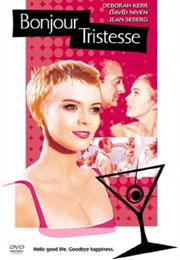
I've never seen a story quite like Otto Preminger's Bonjour Tristesse, from the novel by Francoise Sagan, in which the ultimate playboy father and his daughter are such affectionate pals that their relationship almost substitutes for any other lasting love relationships.

I've also rarely seen such a convincing depiction of hell on earth, though Cecile uses the term 'Limbo,' which is even more suggestive. In fact, I've rarely seen so strong a film give up its game so openly. Cecile narrates her situation openly and honestly from the beginning, and in the end it's hard to know whether she has learned enough to ever escape. The film gives me the strange feeling of "slumming" with the rich.

Deborah Kerr and David Niven are excellent in their roles. Kerr is convincingly beautiful and sophisticated enough to summon a mature fascination from Raymond, yet stern and confrontational enough to alienate Cecile, who actually desperately needs her good influence. Kerr is such an intriguing actress, clearly a great film actress who amassed a particularly impressive body of work, yet she is so old-fashioned. Her work is often defined by sexual passion, but there is something profoundly prim about her. Like Julie Andrews, she seems the quintessential governess, or is at least always battling such a perception. (Of course, Kerr played a nun more than once, let alone a governess, famously, in The King and I.) Here she believably plays a sophisticated designer from the highest world of fashion who finds herself competing with chic young women who sport her designs. From almost the moment she enters, there is something deeply stormy in her temperament that prepares us for the tragic confrontation to come.

Niven's character is admirably well-rounded, managing to be both suave and charming, yet at the same time deplorable. His portrayal clinches the theme of the tragedy of misguided parenting. Mylene Demongeot is enormously charming as Raymond's summer fling, vivaciously cute with her adorable accent yet superficially selfish to a fault. (I was also happy to spot Martita Hunt in a small part. She had such wonderful presence in Preminger's Bunny Lake is Missing, and, looking her up, I find she became famous for playing Miss Havisham in David Lean's 1946 Great Expectations.)

Star Jean Seberg, in her second role, working again with her discoverer Preminger, is a unique presence. She narrates the film in a way that usually doesn't work in film. She also delivers her lines in a distractingly well-enunciated style. These quirks may be off-putting for some in the audience, but they are part of the film's style, and I adjusted to them quickly. Besides, delivery is only one facet of acting. Seberg's movement is gorgeously fluid, and her look (petite, feminine, with a tomboy haircut) is stylishly modern. When she gazes directly into the camera (though she's actually looking at the chanteuse Juliette Greco singing the haunting title song by Georges "Les Six" Auric in a nightclub scene), she breaks my heart. Of course, her sad personal story lends power to the sadness here.

The cinematography by Georges Perinal (who shot such major films as Le Million, The Life and Death of Colonel Blimp and A nous la liberte) is excellent, using a mix of color and black&white to express a before and after, two states of the soul, one of ignorance, even a kind of innocence, and the other of deepest remorse. The French Riviera never looked so beautiful (sparkling, blue water) and yet so haunted. The camera keeps more of a distance from these characters than usual, which, combined with their sometimes ugly behavior, helps us to maintain perspective without getting too swept up in the story. It strikes a good balance. One particularly memorable sequence mostly in long shot captures the dance of our main characters in a crowded outdoor cafe late one dark summer night. It reminded me a bit of Tati's much more elaborate final section of Playtime. If they end in limbo, this represents the moment when they are closest to heaven.

Rating: 3 1/2 out of 4 stars.

Song: "Walk Right Back" by The Everly Brothers - heard this before a concert recently for the first time and loved it. Now I'm on an EB kick.

Labels: ,

Tuesday, May 17, 2005

Agnes Jaoui's latest film, Look at Me, is a worthy followup to her excellent The Taste of Others. When I first saw Taste, I started thinking of her as a kind of French Woody Allen. Turns out everyone's been making the comparison, and as she politely points out in a recent profile, the comparison doesn't really fit. Seeing her new movie and revisiting her earlier film (which holds up beautifully), I see how wrong I was, but I'll be less polite about it.

Allen and Jaoui are both middlebrow writer-director-actors, but the comparisons should end there:
  • Woody's characters serve (too often simple) concepts. Agnes creates rounded characters.
  • Woody hogs the spotlight, playing the hero or forcing other actors to adopt his every mannerism. Agnes keeps herself in the supporting ensemble.
  • Woody seems unable to collaborate, to the detriment of his work. Agnes has a writing and acting partner, the excellent Jean-Pierre Bacri.
Jaoui's stories are impressive for their psychological insight, her favorite being that people crave love and attention most from those who spurn them. It's the main theme of Look at Me, but it's also a dynamic at work in Taste. In fact, her movies demand that we puzzle out the characters' psychology. Plot is secondary. I've never seen a character quite like Castella (Bacri) in Taste (the title refers to the challenges--and necessity--of relating to others when their tastes are different from ours). A mildly boorish businessman, begrudgingly dragged to the theater out of social obligation, is struck by an unlikely lightning bolt of artistic appreciation, and it turns his life upside down. Seeing it a second time, I'm esp. impressed with the secondary character arcs.

Rating: Look at Me 3 1/2 out of 4 stars
Rating: The Taste of Others 4 out of 4 stars.

I can't believe I haven't seen Advise & Consent yet. Preminger is one of my favorite directors, and the case has been made that the film (newly issued on DVD as part of the "Controversial Classics" box set being advertised in slick magazines everywhere this week) is more timely than ever.

Been watching Batman reruns for the last month, which I hadn't seen since I was a kid. Eli Wallach once played Mr. Freeze (a part established by the aforementioned Mr. Preminger), an episode I haven't seen yet. But I was looking at Wallach's new memoir, The Good, The Bad, and Me in the bookstore the other day, and in it he says he was urged to take the part by his children and that he was paid $350. He was chagrined decades later to read that the Governator was paid $20 million for the same part. Me, I think I'd have rather seen Wallach get the loot.

Song: This Heart is a Stone by the Acid House Kings, a twee but delicious song stuck in my head thanks to Swedes Please.

Labels: ,