Monday, July 14, 2008

Shortlists, Retrospectives, Appreciations, and Bug Porn

Have you heard? Missing footage from the film classic Metropolis has been discovered. Cool!

"Give us back our shortlists" - in a nutshell, this columnist chides the current Frank O'Connor award jurors for skipping the shortlist stage and simply announcing the winner, Jhumpa Lahiri. I agree. I'm not a big Lahiri fan, but that's beside the point. I don't begrudge her winning (though does the only short story writer to top the bestseller list in ages really need this little award?), but I do think a shortlist should have been announced, and I don't want to see this become a trend. I'm the kind of reader who looks at shortlists and finds them useful in deciding what to read. The top 5 in any literary finals are generally strong, and there's usually something on any such list that I just needed a bit of encouragement to try. Somehow, I think the odds are much lower that a list of one will inspire me to read. OR. TO. BUY.

Two articles On the films of Hal Ashby: there's a retrospective of his work going on out West. Wow, that's a series I'd love to see. I'd never heard of The Landlord in particular, and it looks fantastic. The rest are on dvd, and I just may screen my own series at home if the series doesn't come to town.

I agree with NY Magazine: that was one delicious takedown in the Times a few weeks back. I usually resist reviews that are so nasty, but it just so happens that I recently picked up another book (Choke) by the target, erm, author in question, Chuck Palahniuk, hoping for an enjoyable if pulpy bit of subversiveness (in other words, exactly what the book's advertised to deliver) and found it so mediocre, so contrived and strained that I had to put it down, which I rarely do. So I was fairly cheering Lucy Ellman on, even though I still kind of wish Palahniuk well in his mission. Oh, man. She included Alice Sebold in her list of overrated hacks. Joy! I'm not the only one, hallelujah! This is one mean review to savor.

On his blog, continuing to clear out his drawers, Jonathan Rosenbaum posts an appreciation of Susan Sontag from 2005. (Hmm, small coincidence: Sontag also wrote the intro for the novella I just finished, Pedro Paramo.) So far, what I've found most interesting here is a glancing reference to the debates which went on in the 60s about whether film could be considered an art form: "What impressed me most in her writing was ... and the fact that all four articles treated film as part of art and thought without any sort of self-consciousness or special pleading—-an approach that seemed virtually unprecedented at the time." I came across references to this moment in film history a few times last year while reading coverage of the deaths of Bergman and Antonioni, but this time it registered more consciously, made me stop and wonder: how strange that film should ever have been discriminated against in this way. I've taken it for granted at least since I was a teenager that film was as valid an art form as literature or theater. Then it occurred to me that perhaps a similar debate has been going on in the last ten years towards comics/ "graphic novels," whatever we're calling them. Perhaps a symptom of these cultural growing pains has been the struggle to name the art form. (The title of JR's piece, btw, alludes to Goodbye, South, Goodbye, directed by Hou Hsiao-hsien, championed by Sontag.) [More Rosenbaum: on Marcel L'Herbier? Who? And on Tati's Trafic, coming soon from Criterion.]

"Three gay and lesbian fiction gems" by Michael Upchurch (who also recently wrote an enjoyable appreciation of Guy Maddin's latest). Enjoyed the McCartney, and I kind of want to read the Maguire.

Are movie critics out-of-touch elitists? And, besides, don't bad movies dominate at the box office, anyway? Apparently not.

The stupid newspapers may be chopping book coverage (right, because you can't make money selling books to the freaks who read newspapers in print), but NPR apparently understands what its audience wants. (I'm not really a big fan of Jessa Crispin, though, I must admit.) Hey, Chicago Tribune, take a lesson as you redesign your paper - don't cut your book coverage, expand it, improve it.

"The Fate of The Sentence: Is the Writing On the Wall?" Or is this a case of silly alarmism?

Looking for something good to read? Check out the Telegraph's "50 best ever summer holiday books" or the Guardian's travel-themed selection, "Friends for faraway places," featuring Dave Eggers on Chicago books, David Mitchell on Japanese books, etc.

"10 Ways to Become a Better Film Critic" - Who is Evan Derrick? This is brilliant.

A little Wikipedia observation. So I was looking up playwright Brian Friel a couple weeks ago and came across startling evidence of a battle among its contributors over the content. This is what it said in the subsection on the play "Molly Sweeney," capitalization exactly as it was:
Molly Sweeney (1993) enjoyed considerable success on the stage, but it attracted little critical interest, perhaps because of its superficial similarities to Faith Healer (1979), another play comprised of a series of monologues. This play is about a blind woman in Ballybeg who constructed for herself an independent life rich in friendships and sensual fulfillment and her ill-fated encounter with two men who destroy her life--Frank, the man she marries who becomes convinced that she can only be complete when her vision is restored, and Dr. Rice, a once-renowned eye surgeon who uses Molly to restore his career. Richard Pine has written in depth on the relationship of his play to Oliver Sacks' work and the controversy that forced Friel to recognize Sacks' work as an inspiration for the play. THIS IS COMPLETELY ERRONEOUS - I HAVE NOT WRITTEN ANYTHING ABOUT 'THE CONTROVERSY THAT FORCED FRIEL TO RECOGNIZE SACKS' WORK' - NOT LEAST BECAUSE I AM NOT AWARE OF ANY SUCH CONTROVERSY. WHO IS THE AUTHOR OF THIS ERRONEOUS STATEMENT?
And this is how it reads today:
Molly Sweeney (1993) enjoyed considerable success on the stage, but it attracted little critical interest, perhaps because of its superficial similarities to Faith Healer (1979), another play comprised of a series of monologues. This play is about a blind woman in Ballybeg who constructed for herself an independent life rich in friendships and sensual fulfillment and her ill-fated encounter with two men who destroy her life--Frank, the man she marries who becomes convinced that she can only be complete when her vision is restored, and Dr. Rice, a once-renowned eye surgeon who uses Molly to restore his career. In a note in the programme of the 1996 Broadway production Friel says that the story was inspired in part by Oliver Sacks's To See and Not See.
You hear about these things, but I'd never really come across such a good example before of how the site is constantly in flux. I read a good point the other day about how WP (the people's Encyclopedia) is not appropriate for citation, not because the information is bad or can't be trusted (that's the route the argument usually takes into heated territory) but simply because it probably won't be the same when you check back. That does kind of turn the whole exercise of citation into an absurdity, doesn't it? You may as well just write in the footnote of your paper, "Well, this is what someone on the internet said on such-and-such a date and time.)

I know it's made the rounds already, but if you haven't seen Isabella Rossellini's funny "Green Porno" series, you should take a peek. Isabella, you are a goddess.

Finally, the movie "Ben & Arthur" is currently at #8 on the imdb bottom 100, and you really have to watch the trailer to appreciate just what's gone wrong with gay independent filmmaking - or perhaps independent filmmaking in general. (Or wait: maybe it's an intentional satire, and it's actually wickedly brilliant and...and...)

Labels: , , , , ,

Wednesday, December 26, 2007

The Great Transition: World Cinema in the 1950s

One of the highlights of the last few months for me was a series at the Gene Siskel Film Center called "The Great Transition: World Cinema in the 1950s." A lecture series, it was curated by Jonathan Rosenbaum, a film critic I greatly admire. I was saddened to read that he's about to announce his retirement. To be honest, it's something I've been dreading. As head of the film section of the beleaguered Chicago Reader, he's assembled a team of critics like no other whose reviews I've come to depend on. Losing him is bad enough, but the question is, what will become of the Reader's film section without him? In my opinion, deputy critic JR Jones has grown from an interesting critic who often got things wrong into a great critic who's usually right, so I wouldn't mind seeing him in charge. But is that what we'll get? Does this change really mean we're losing Jones, Gronvall, Camper, Graham as well? Perish the thought. And what about the capsules from Kehr that Rosenbaum ran as editor?

Mr. Rosenbaum is one of those writers who has become like a friend for me, certainly like a beloved professor, his thought-provoking opinions something I'd miss terribly. I often disagree with him, but he's been consistent in the maturity of his views. With him you always feel his opinions are grounded and well thought out - an excellent source of support if you agree and an enjoyable opponent if you disagree. Though he is sometimes reduced to a leftist politico, this characterization fails to hold up under the laziest scrutiny. In fact, this lecture series has only reinforced for me the agility of his criticism, his deep impulse to resist the didactic in every way. He's long been an inspiration for me in transcending knee-jerk political thinking. Time and again I've found this charge of leftism to be the opinion of people who resent his aesthetics, his consistent championing of arthouse fare as well as Hollywood work. It doesn't matter than 99 out of 100 critics treat Hollywood as the center of the film universe, it is still too much that 1 critic has a different focus. Crazy. Such people are unfailingly unwilling to believe that he actually champions Hollywood pictures on a regular basis.

Rosenbaum caused two major controversies this year - the first when he wrote in the Times that Ingmar Bergman needed to be reassessed, the second when he ran a review that disagreed with the general acclaim for No Country for Old Men. (The latter piece strains for socio-political insight, but I agreed with the gist - a technically fine movie but spiritually dead. David Edelstein handled his criticism of the film better. I have a ridiculous amount to say on both controversies but will refrain for the time being.) Blogs and message boards oozed vitriol and the more opponents (including the convalescent Ebert) frothed, the worse they looked by comparison. Rosenbaum apparently is retiring because he's 65 and not because of these controversies or because of the sad financial decline of the Reader. He will also continue to write (including for the Reader web site), so I'm trying not to worry for the time being.

*

At any rate, I was able to attend a few screenings in the weekly series on 50s cinema, and I enjoyed them a great deal. I eagerly await the follow-up series about the 60s coming this Spring. The entire 50s series is listed on the Film Center's calendars (Sep., Oct., Nov., Dec.). They list these words from Mr. Rosenbaum by way of introduction:
In between Italian neorealism and the European new waves, one can find a ferment of creativity in many different cinemas around the world. This two-part series will investigate the phenomenon in all its complexity and diversity. Mainstream and independent films from the U.S., France, Sweden, and Japan will be among those represented. In Part One, devoted mainly to the 1950s, the critical writings of such critics and future filmmakers as Jean-Luc Godard, Jacques Rivette, and Francois Truffaut will be discussed alongside many of the films they championed and wrote about, such as Nicholas Ray's PARTY GIRL, Robert Bresson's A MAN ESCAPED, and Howard Hawks's THE BIG SKY.
While this intro paints the series fairly seriously, I hasten to say it was actually a lot of fun. The overall aim may have been to explore a cinema in transition, but I got the feeling that our curator was at least as interested in simply sharing some favorite old films, to give Chicagoans access to some lesser-known films. Art Institute students enrolled in the series as a class may have gotten more of the advanced critical writings, but as a member of the public (and of the Film Center, which got me a reduced rate) I was able merely to attend the screenings I wished without worrying about note taking. I stayed for 2 or 3 lectures, wishing I could have attended more.

The first film in the series I attended was The Story of Three Loves, an example of that rather rare bird, the anthology film (in color, despite this picture). As I've become a Vincente Minnelli fan, it's probably no coincidence that it's probably my favorite of the films I saw in the series. The first story (directed by Gottfried Reinhardt) tells the story of a love between an impresario (James Mason, ugh, not one of my favorite actors) and a dancer (Moira Shearer, donning her ballet shoes for the camera once more years after her success in The Red Shoes). Agnes Moorehead added interest in a supporting role, and the story was romantic, melodramatic and only fairly good. Much more enjoyably, eleven-year-old Ricky Nelson plays a boy who wishes to be a man so he can escape his French governess (cute Leslie Caron) in the Minnelli directed second segment. A witch named Hazel Pennicott (so memorably played by Ethel Barrymore) grants his wish, transforming him into Farley Granger...for a limited time. Predictably yet enjoyably, as an adult he has much more appreciation for his governess. Delicious. The final segment (Reinhardt again) tells the story of a trapeze artist (FD fave Kirk Douglas) urging himself and his love interest (Pier Angeli) into a dangerous high-wire act. Awkward in spots (and Douglas, as so often, veers into overracting, not to mention those silly tights), the story builds a white-knuckle suspense when both cameras and actors move higher and higher into the air. The grown woman next to me was clutching her date and the armrest we shared. Rosenbaum discussed the way the storylines (esp., as I recall, the latter) evidenced the influence of French existentialism in pop culture of the time, an international trend that seems (to me) difficult to imagine happening now. Personally, I savored the queerness of the project - the emphasis on artists as characters, the casting (Moorehead, Granger), the melodrama. Very enjoyable.

I attended Party Girl because I'm a Nicholas Ray fan, but I'd have to say I felt this film was a bit of a letdown. Still, it is intriguing. Set in 20s Chicago (another reason to see it), it's the story of a dancing showgirl (Cyd Charisse) and a crooked lawyer (Robert Taylor) falling in love and trying to escape a mobster's control. Rosenbaum saw it as an intriguing example of Ray's theme of flawed lovers coming together to create something greater than the sum of their parts. With the "transition" theme in mind, I saw it as an interesting example of MGM's growing pains, going from the glory days of their musicals to something dramatic and serious. The aging Charisse shines when she gets to dance (she's still got it at this point), though the costumes will bring laughs now (as they did when I saw it), and I thought she was less than compelling otherwise. The violent conclusion is likewise ridiculous. It's not quite a case of actors wrestling rubber squid-monsters (a la Ed Wood) but they do act rather unbelievably. Of interest thematically for Ray fans, then, and not otherwise recommended.

I saw two Jacques Tourneur films in the series, and Stars in My Crown was the first. I have a weakness for both Joel McCrea and for these mid-century films of nostalgia (like Meet Me in St. Louis and Heaven Can Wait), so I enjoyed this very much, though I think many of us in the audience were surprised and uneasy to discover that the story included the threat of a lynching. It's handled quite well, though. Difficult to summarize, but the story, as seen through the eyes of the young Dean Stockwell, features a tough, good-humored Parson (McCrea) in a rural Southern town, a young science-minded doctor setting out to take over his ailing father's practice, and a rich mine owner (Ed Begley) looking to take advantage of an old black farmer. Alan Hale supports as the head of a big family of strapping farmers who provide some comedy. Some people online have described it as 'Americana' and as a Western, both of which do fit the tone. I loved it and found it thoroughly enjoyable. Rosenbaum highlighted the perennial Tourneur theme of the power of absence to engage people's minds (there's a letter near the end that illustrates this theme), not to mention the overall darkness of various episodes in a story which overall feels quite light and warm. From his capsule review: "recalls some of John Ford's best work in its complex perception of goodness."

Murder by Contract has a reputation as the best film by director Irving Lerner but also the only real keeper in his output. Still, the film looms large, an influence on Scorsese's career as well as on Jim Jarmusch's Ghost Dog. (Actually, a scene in a barber shop also made me think of Cronenberg's Eastern Promises.) It's fascinating, actually, one of those films you can't quite believe has never made it to dvd. A young and handsome Vince Edwards plays an ambitious young man who becomes a hit man--oddly, those ambitions are rather normal and middle-class: he wants to save up money for a dream house in the midwest. He's just impatient about getting it quickly. The script is witty, humorous even, without losing the edge of a crime drama. Perhaps it's a side-effect of its minimalism (employed effectively to make the most of a low budget--the film feels very independent), but the story raises all kinds of interesting, even bizarre questions. Again with the existentialism, and there's also something Nietzschean about Edward's character. Very much ahead of its time.

The second Jacques Tourneur film I saw in this series (and Tourneur was the only repeat director in the series) was Curse of the Demon. This was a mild letdown for me, but there was enough of interest that I didn't regret seeing it. It was a strange note to end on, but I was glad I stayed for the lecture/q&a this time as it really deepened the picture. It's a supernatural story based on M.R. James that involves a demon (that looks like something out of godzilla), a devil cult leader and an American doctor crusading against superstition. (Oh boy, you never want to be the rationalist in a supernatural story.) When I asked him what connected this picture to the other Tourneur (they're such different films), Rosenbaum again stressed Tourneur's consistent belief in the power of absence and darkness to fire power people's imaginations. (This reminded me of Cat People.) But I was also struck by the fact that in Stars in My Crown you have the pastor and the atheist doctor disagreeing on philosophies and here you have the rationalist and the occultist. (Later I watched I Walked with a Zombie in which I saw this conflict echoed once more.) Rosenbaum was surprisingly candid about Curse's many contradictions and flaws, but he was fascinated by the fact that Holden and Karswell are in many ways the same person and that at other times their behaviors seem the opposite of what they should be. The longer the post-film discussion went, the more oddities and nuances we found, so despite my slight disappointment, it's worth a viewing.

Update: Thanks to GreenCine Daily for the link. It's my favorite film blog, and I subscribe by email (as well as RSS) so I never miss an entry. A bit of a thrill to see my own words there. (I'm such a geek.)

Labels: ,

Friday, August 24, 2007

James Wood, Film Polls, This-and-That

Just read James Wood's excellent work of criticism on DeLillo's Falling Man. It's searing, certainly balances out more on the negative side than I would have gone, but there's a lot of truth in it. Anyway, I set out looking for more from Wood (I found some) and learned that due to TNR's financial woes, Wood has been scooped up by The New Yorker. (Snarky version of the news here. Smarter reaction to this news here.) I hope this means I get to see more of his work. Update: Best article on Wood's jump yet.

Film Grotto has compiled a top 100 film list out of a bunch of critics' top tens. Results kick AFI butt.

Blogger Edward Copeland invites you to vote on the best non-English language films.

How often do film critics get in front of the camera? I had no idea Jonathan Rosenbaum ever made a movie.

This year's CIFF is dedicated to Roger Ebert. A lovely gesture.

Twitch ran an interesting post about supposedly "unfilmable" books and the dream match-ups of directors (a couple I had to look up) and material.

Excellent coverage of the LOGO presidential candidate debates. Graff, a writer I once corresponded with, is a gem.

The Times fucks up again.

Labels: ,

Friday, January 19, 2007

Rouge and A.O. Scott on Foreign Film

The other day critic Jonathan Rosenbaum was singing the praises of Rouge, an online film magazine, so I was doing some browsing. It's fairly serious and highbrow (no big shock, given JR's taste) but I've already found some fun stuff. Issue #5 was devoted to still images, and it's fun to browse through. My favorites were: Adair on Astaire, Cuerda (a director I'd never heard of), a shot from the film Weeping Meadow (which I have yet to see), stills from Ford and Ozu, a clever piece by Grant McDonald and lastly: this piece on Teresa Wright. This is what I was trying to say not too long ago (here and here). She's magnificent!

*

A.O.Scott had an interesting topic the other day in an essay wondering why Americans don't see more foreign films. I think he got at some of the issues, and I appreciated the point (I read this as a mild critique of Rosenbaum's writing) that the notion that large numbers of Americans would see foreign films if only they played in their multiplexes is wishful thinking. But I think Scott's only halfway there. A bigger problem is that the critics' favorites from others countries are highbrow art films (Kiarostami, Ming-Liang, Angelopoulos, etc.), often very arcane work that is aesthetically anti-Hollywood in the extreme. We're not just talking about reading subtitles, discouraging enough to some, but choosing to be baffled by a style of art that's alien to most Americans and a pace that bores most people who are used to Hollywood/television aesthetics when they could instead watch some excellent and accessible television.

If critics really wanted the American mainstream to embrace foreign films, they'd also champion foreign work made with more mainstream aesthetics. There's room for both in the market (look at martial arts films), but in privileging "contemplative cinema" over genre work, the film critics have been foreign language cinema's enemies as much as they've been its friends.

Labels:

Friday, September 01, 2006

Film News 9/1/06

Supercritic Jonathan Rosenbaum has contributed an essay to the DVD of Kicking and Screaming and commentary to the latest Criterion edition of Playtime. He's also been contributing a series of fun articles to DVDBeaver.com. I saw an interesting quote from him in a review of The Last Movie.

Joss Whedon won a Hugo award for Serenity. He also recently made a list of favorite tv characters which is written in his trademark style. Rumors continue to flow about who might play Wonder Woman. Pay no attention. Speaking of Whedon, Amber Benson (beloved for her role om Buffy) will guest on an upcoming episode of Supernatural.

The Beat has information on Ursula K. Leguin's reaction to the movie version of her book The Farthest Shore made by Studio Ghibli.

Q World Video asks notable personalities about their favorite gay films. Recently they asked Wash Westmoreland (Co-director of Quincenera and The Fluffer with husband Richard Glatzer):
My favorite LGBT film is A TASTE OF HONEY, a "kitchen sink" drama set in Salford, England in the early sixties. It is the story of Jo (Rita Tushingham) a teenage girl who is abandoned by her gloriously wanton mother (Dora Bryant), gets pregnant by a black sailor (Paul Danquah) and shacks up with Geoff (Murray Melvin), a young gay man she meets in a shoe shop. Geoff's character has no coming-out moment, no self hatred, or angst over his circumstances; he just moves in with Jo, starts "doing the place up" and thereby forms one of cinema's very first queer families. Made at a time when homosexuality was illegal in Britain, the film was the vision of a 19 year-old usherette, Shelagh Delaney, who, legend has it, was bored with the irrelevance of the plays in her theater. It was a big influence on QUINCEANERA , which features a pregnant latina and her gay cholo cousin. In both movies, the affectionate central relationship is clothed in antagonism and irreverence. "What do you do?" Jo asks Geoff with blunt curiosity, "Go on tell! I've always wanted to know..." And this was in 1961!"
I found this interesting because by coincidence I recently watched A Taste of Honey, and when I saw Glatzer's (very solid) film, I could clearly see the influence.

Dalkey Archive is moving from Illinois to Rochester, NY. This neck of the woods will be a bit sadder, but at least they seem to be thriving.

Labels: ,

Tuesday, May 09, 2006


This Week's Movies

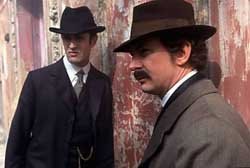
For fun I rented Sherlock Holmes and the Case of the Silk Stocking, a recent Masterpiece Theatre production. Impressive production values (MT's come a long way!) and a high-quality cast, but unfortunately Allan Cubitt's script could have been better. The story was very much in the vein of CSI / Silence of the Lambs, to the point of cliche. Think serial killer. Think a signature object left inside the victims' throats. Imagine Holmes and Watson discovering they have the wrong man and having to race to find the culprit before the latest victim (who they used as bait) expires. Not exactly a nail biter. More importantly, I have to get this off my chest: it takes more to satisfy Holmes fans than just ticking items off a checklist of Holmesiana: a reference to his drug use (ok), got him reading a book about bees (yup), reference to his sexuality/problem with women (got it), playing violin (mm hmm). Thing is, you've got to do something meaningful with these ideas.

Still, Cubitt and director Simon Cellan Jones wisely follows in the mold of Billy Wilder's The Private Life of Sherlock Holmes. The two characters are portrayed at a point after Watson has moved out of the bachelor's quarters of 221B Baker Street. Watson is concerned as friend and doctor by Holmes' drug use. Watson is pursuing romance, Holmes isn't. (In fact, in this story, Watson's on the cusp of marriage.) There's also the enjoyable feeling of excitement that they get to work together again--a feeling that taps into our longing to resurrect the duo for further adventures. Best yet, Rupert Everett is a natural choice to play Holmes--he's physically perfect for the part, with his height and his prominent nose and chin, not to mention the aristocratic demeanor that can give him a chilly and effortlessly superior air (a quality he got to do even more with in Separate Lies). If you can overlook the opening pose he's directed to give, the performance is quite good. Ian Watson is also a grand Watson, the best I've seen yet of the few I've sampled so far. Helps that he's an unusally good and criminally underrated actor. His Watson is a friend of perhaps greater common sense than Holmes and, here's the key: less intelligence than Holmes but not less intelligence than the average man.

It breaks the illusion of time-travel you get from reading Conan Doyle, but in a way I enjoyed seeing Watson's fiancee, a bold and modern American woman psychiatrist, expose Holmes to Kraft-Ebbing, though of course with the modern serial killer angle thrown in it degenerates into an excuse for a kinky killer. I get it. Out with the Victorian world, in with our modern world. It's the lesson of way too many Holmes pastiches--but is our world so much less interesting than Conan Doyle's? I don't expect the thrill of exploring the Victorian mentality I get from Conan Doyle, but can't I be thrilled by exploring the Edwardian era? It's still pretty long ago--a century. Rating: 2 out of 4 stars.

Also watched David Lean's masterful Brief Encounter. Trevor Howard is excellent and Celia Johnson is outstanding as two married people who cross paths, fall in love, and struggle with what to do about it. At the end I asked Red if he thought she made the right decision, and it turned out we'd just watched two completely different movies. He saw Alec as predatory and I saw him as hesitantly seductive (for once the Adam and Eve roles are reversed). Only fully-dimensional characters can lead to such a satisfying disagreement and discussion. I was impressed with the cinematography (and what a sparkling clean-up job Criterion did) and the way Laura's narration comes across so dreamily and fluidly. (Spoilers ahead.) It's one of those movies that captures a lifetime in 86 minutes--birth, prime and death...of a love affair, of a potential life. After seeing it can you ever forget the full-circle impact of that chatterbox's interruption? The spaces and rhythms of the story works so well: those Thursday rituals, the movie matinees (with Donald Duck and B-Movie Tarzans), the lady cellist, the tea room rendezvous, the trains in opposite directions. I enjoyed and admired the comical counterpoint involving the guard and the tea room matron. And I'll confess a weakness for the Rachmaninoff. It's poured on shamelessly thick, but that's the way I like old b&w romantic stories. I've seen a few I've liked slightly better--this story was just a bit thin for my taste, needing perhaps just another episode for thickness, but it was time well spent. Rating: 4 out of 4 stars.

Continuing my interest in Preminger and in Dana Andrews, we also watched the new-to-DVD Fallen Angel, a noir that I'd rank far behind Where the Sidewalk Ends and Laura. Andrews seems a bit tired playing a fairly despicable con man. Linda Darnell is strong as a femme fatale and Alice Faye actually refreshing as the goody-goody who stands by her man when he's suspected of foul play, deserving of punishment if not quite guilty. Percy Kilbride (who I've enjoyed quite a bit recently in State Fair and Keeper of the Flame) and Charles Bickford (as a troubled cop from the East) have supporting parts that are somewhat less than satisfying. It's yet another noir story that sees California as part-Wild West and part end-of-the-line, a place you end up when you've been on the run (with a very similar set-up as the much worse The Postman Always Rings Twice--man gets to California looking for a new life and walks into a little diner). The film is competent, but overlong (actually made me sleepy at times). Not recommended. Rating: 1 ½ out of 4 stars.

Miscellaneous

You know how they do those sing-along showings of movies like The Sound of Music? In some places they've done them for "Once More with Feeling," the musical episode of Buffy the Vampire Slayer.

Chicago Reader movie critic Jonathan Rosenbaum is one of the writers and creative types I keep an eye on as I follow the news online. He's been a bit off his game lately, but he's still one of the world's finest, in my opinion, and not only do I follow his work, but I also follow what others are saying abou him. Here are some tidbits collected since the beginning of the year.

Early in the year I noticed a swipe from critic Scott Renshaw, holding up Mr. Rosenbaum as a humorless symbol of anti-commercial views (and, worse, lumping him together with nutcake provocateur Armond White). It's a common complaint about JR, but it just goes to show Renshaw must not read the unfashionable one's reviews, because Rosenbaum regularly sees and recommends contemporary Hollywood fare (sometimes really bad stuff, like Prime). Truth is, JR has his weaknesses and guilty pleasures just like the rest of us.

More recently, Rosenbaum has gotten a lot of mentions (like here, here and here) for his contributions as a Welles expert to the Criterion edition of Mr. Arkadin. I look forward to seeing this movie and listening to his commentary.

In an article on Art School Confidential, Paste Magazine recently mentioned that he once compared Rear Window to comic strips, which is a nifty little insight.

Mr. Rosenbaum is a member of the National Society of Film Critics and serves on many international film juries, including, recently, the Jeonju International Film Festival in Korea.

Critic Andrew Sarris, who I also try to keep up with, apparently is a big fan of The Ballad of Cable Hogue, which was recently issued on DVD.

Song: "God knows(you gotta give to get)" by El Perro del Mar

Labels: ,

Tuesday, August 09, 2005

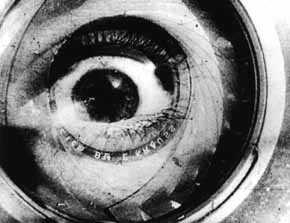
Watched Dziga Vertov's The Man with the Movie Camera for the first time last night. I can't pretend to have fully digested it fully, but I found it stylistically exciting and ideologically challenging. It's a film about film, as you might guess from the title. Although I only got to listen to half of it before returning the film, I found Yuri Tsivian’s commentary exceptional (the best since the one I heard for Antonioni's Blow-Up). From first viewing, I had the sense that the piece was strongly propagandistic in a Soviet style and that it was at least somewhat organized around the idea of a day in the life of The People. Tsivian clarifies that the film is actually a manifesto in images (after an introduction which is a brief manifesto in words), and he contextualizes the film by discussing the trend at the time of city symphony films that follow a day in the life of the city and just how Vertov's film differs from those. He also offers an excellent close reading of individual sequences and their intended meaning. This was helpful to me because the style of the film, though bold, is rather unfamiliar.

There are a few things going on in the film. First of all, there is a passionate and idealistic celebration of the common man and woman, especially the common worker, one might expect from early Soviet history, your basic Marxist ideology. More interestingly, the film has an agenda regarding filmmaking: to fully expose (or "unmask," Tsivian says is the favored term of the era) the process and techniques of filmmaking. Vertov and co. foreground that process as equal subject matter, showing cameras in the shot, giving close-ups of the lens, showing strips of film being edited and put in motion for the film effect, showing the projectionist at work in his booth. This was a bit tiresome to me because, today, we all know how film works. In 1929, though, this education may have been important for the masses, and it's made tolerable today because of the highly witty and meaningful way Vertov expresses these ideas, using visual metaphors of elegance and concision. At the same time, the film seems to demonstrate nearly every possible basic technique in the filmmaker's arsenal, including stop-motion animation, collage, freeze-frame...you name it. It's inspirational. It makes you want to grab a camera and get to work.

Tsivian helped clarify for me the meaning of the recurring image of a movie poster of a man and woman. Apparently (and the film made more sense to me once I knew), Vertov's manifesto stood against the conventions and style of commercial cinema, of fiction films, of the fostering of dream-reality. Film, in Vertov's view, should be used to open our eyes (there's a recurring image of awakening), not to indulge in escapist fantasy. For that reason, I was glad this film wasn't more influential (not that there was much chance of that). I love the Hollywood dream factory and believe that audiences are intelligent enough to analyze what they see in fiction filmmaking. They'll certainly rise to the occasion when properly challenged. This film places too much faith in the titular man (not woman, you notice) behind the camera to express "truth" or "reality," and Vertov's too-sober attitude that narrative, fiction filmmaking is corrupting or narcotizing is vaguely insulting and certainly more than a little starchy, the stuff of overly earnest leftists of a certain type.

That being said, its intelligence, meaningfulness and stylistic bravado are something to celebrate. Every professional filmmaker should see this film.

Rating: 4 out of 4 stars.

American Cinema: Directors and Directions 1929-1968 is one of my favorite film books. Sarris is one of the few (including David Thomson) who has a gift for summing up an entire while satisfyingly including the key details. I may not always agree, but his judgements are invaluable. I'd love to see what he does with today's major directors. So I was thrilled to read the following in Andrew Sarris' column last week:
Since I decided recently that I was going to live forever, I figured that I had enough time to update The American Cinema, Directors and Directions 1929-1968 to the 21st Century, beginning with Richard Linklater, whom I am tentatively placing in the category “The Far Side of Paradise.”

Still in his 40’s, Mr. Linklater may have a stab at making my pantheon of English-language auteurs, which takes in Canada, Australia, New Zealand, Ireland and the British Isles. Among the other recent auteurs I am following (though sometimes from a great distance) are: Robert Altman, Harold Becker, Robert Benton, the Coen Brothers, Francis Ford Coppola, Jonathan Demme, Clint Eastwood, the Farrelly Brothers, Peter Jackson, Jim Jarmusch, Ken Loach, David Lynch, Terrence Malick, Michael Mann, Errol Morris, Mike Nichols, David O. Russell, John Sayles, Martin Scorsese, Steven Soderbergh, Steven Spielberg, Quentin Tarantino, Gus Van Sant and Terry Zwigoff … but I am still very early in my research.
And I was amused to read this passage in Roger Ebert's review of Broken Flowers:
Jim Jarmusch first came into focus in 1983 with "Stranger than Paradise," about a slick New Yorker who gets an unexpected visit from his Hungarian cousin, who is sexy and naive and soon leaves to visit her aunt in Cleveland. Then followed a series of films of various degrees of wonderfulness; I have admired them all except for "Dead Man" (1995); the critic Jonathan Rosenbaum regards me sadly every time this title is mentioned.
Yeah, I'll just bet. It's so weird to me that the two of them must run into each other constantly at Chicago screenings. They're so different in so many ways.


Song: "Sénégal Fast Food" by Amadou and Mariam

Labels: ,

Wednesday, June 15, 2005

Hayao Miyazaki is currently one of my very favorite filmmakers. Not only do I consider him an heir of (and in some ways superior to) Walt Disney, but I also think he's the greatest fantasist creating for the screen. So I've been looking forward to his new film Howl's Moving Castle for many months. It was every bit as wonderful as I'd hoped.

I recently caught up with a couple of his key earlier films that were just issued domestically on DVD, Porco Rosso and Nausicaä of the Valley of the Winds (both excellent), so watching Howl my eye was drawn to the recurring imagery and themes: machinery vs. nature, pastoral European-inspired landscapes, clouds, flight, war vs. peace, magic, big buglike creatures, anthropomorphism (common in animation, of course), transformation, etc. All of these come into play in the new film, and yet somehow it forms a completely new story.

Many (including A.O.Scott) have started pointing out his predilection for spunky young heroines, but watching Howl I started thinking about how the heroines usually encounter a powerful and creative young hero who helps them but who ultimately needs their help. It struck me that Miyazaki may identify with the characters at least as much if not more than the heroines, that these wizards and pilots and princes may represent the artist, who needs the audience not for mere attention but in order to create something complete, whole. So that's my deep thought for the day.

One thing Red and I puzzled over after seeing the film is the way Sophie's age changes from moment to moment under her spell (not just from young to old but in between). I love the way Rosenbaum addresses this:
"Miyazaki, now in his mid-60s, has a refreshing and persuasive way of relating youth to old age and callowness to wisdom. Rather than presenting them succeeding each other and fighting for supremacy, he shows them coexisting peacefully. And he does this with characters so nuanced and real one keeps discovering new things about them at every turn.

A recent daylong reunion of my grammar-school class gave me back a few flashes of myself as a child. Howl's Moving Castle did the same thing, bringing back images from dreams I'd long forgotten -- dreams of distant lands and immense aerial vistas. I can't swear these were dreams I had as a kid, but it's irrelevant, because in some way we're always children when we dream. And as adults we're always rediscovering and revising our childhood -- which is related to why Grandma Sophie keeps recovering her 18-year-old self and then teaching that self a thing or two."

I'll have to pay closer attention to that idea next time I see it.

The image above is a Japanese poster for the film. It's interesting to see how different the posters are from country to country

The New Yorker ran a fantastic profile of Miyazaki a couple months back, essential reading. I can't find it online, but they have posted an interview with the article's author.

Rating: 4 out of 4 stars.

Stumbled across yet another film, Ripley Under Ground, aka Mr. Ripley's Return, that I'd like to see but which may not get a theatrical release or even (for all I know) a DVD release. I can't find any recent news about it, and Lion's Gate (which had acquired it) lists nothing about it on their site. Sometimes the system sucks.

Song: "Your Daddy Don't Know" by The New Pornographers (cover of a song by Toronto, which is in iTunes)

Labels:

Saturday, November 06, 2004

The Awful Truth about Screwball and Film Noir


Saw an old screwball classic today, The Awful Truth, starring Cary Grant and Irene Dunne, and it's one of the best, funniest screwballs I've seen yet (out of the dozen or so I've seen so far). I realized there are different screwball formulas. My favorite screwball of all time, Bringing Up Baby, like the 70s neo-screwball comedy What's Up, Doc? which draws inspiration from it and other classic screwballs, has a nutty, smitten woman chasing an uptight man until wild circumstances allow him to let his guard down and see that he loves her, too. The formula of The Awful Truth, on the other hand, like that of Mr. and Mrs. Smith, the Hitchcock film I wrote about recently, is this: a married couple become unmarried after a superficial spat and then, in an attempt to deny their continued feelings of love, proceed to sabotage each other's subsequent affairs. It seems there are never children in a screwball, but there are often animals, both domestic and wild. Funny that Mr. and Mrs. Smith should come up, since, by coincidence, in The Awful Truth there's an adorable and hilarious pet dog named Mr. Smith (who, I'm told, was a star in his day--certainly a great talent and a scene stealer). My biggest problem with the Hitchcock picture was that it got too spiteful and mean, so that you couldn't root for the couple to get back together. You might feel they deserved each other, but the film's sense of romance gets shot by the end. Not so in the vastly superior The Awful Truth, which, through a deft combination of direction and acting, gets just the right recipe: great handfuls of comedy, a dash of strong wistfulness, and a consistent flavor of romance.

Then there's the nutty ensemble screwball, such as many of Preston Sturges' films. Recently, I was absolutely bowled over by a stunningly good film, I ? Huckabees. It's one of the few successful neo-screwballs of the last several years (artistically, at least--the box office has been meager so far, though it's only been in limited release). I'd classify it in the crazy ensemble screwball formula, but it's so much more original than that makes it sound. While there are romantic elements, the film is ultimately about philosophy, about the big questions of life and how we cope with the crises of modern life, yet rather than coming off as pretentious, the film somehow feels very relevant. Imagine: a firefighter who's reexamining his life post-9/11, played by Mark Wahlberg (in perhaps the film's most surprisingly impressive performance). Except you won't notice its profundity or its relevance because you'll be too busy laughing.

It's perhaps my favorite film of the year.

Lately I've been thinking how much more I like screwball comedy than film noir. I've been part of a movie discussion group, and this year we watched 10 or so examples of film noir, most recently Out of the Past. Because many of us had already seen them before, we tended not to watch the best, most famous noirs, but we still chose highly regarded and well-reviewed titles. As time went on, it became clear that they all tend to be pretty much the same, with crazy MacGuffin plots that keep your brain scrambled but never add up. Only a very few film noirs have ever really impressed me (Gilda, for example, or to some extent Laura), but I've had a better average finding great screwballs. Plus, great screwballs tend to be exhilarating and romantic; film noir tends to leave one in a cynicial mood.

Critic Jonathan Rosenbaum recently put it best:
"Is there any way to win?" asks Kathie Moffat (Jane Greer), archetypal doom-ridden noir heroine in Out of the Past (1947), addressing Jeff Bailey (Robert Mitchum), archetypal doom-ridden noir hero. He replies, "There's a way to lose more slowly." When it comes to politics in art, the mannerist noir style seems to be one of the most attractive ways of losing slowly. It makes doom more voluptuous and artful than success, makes a film's characters seem "half in love with easeful Death," as Keats put it. I often wonder if the fondness many leftists have for noir films stems from their being suckers for romantic fatalism -- defeatists who wouldn't know what to do with success if it hit them over the head.
Out of the Past is sumptuously made, with excellent performances, exquisite cinematography and some of the sharpest one-liners in the genre (like, "Joe couldn't find a prayer in the Bible"), but after seeing it twice it still doesn't quite satisfy me the way it should.


Labels: , ,

Tuesday, July 20, 2004

Two by Jim Jarmusch


OK, I've been posting much too little here lately. I've decided to devote the next week to movies, movies, movies!

Recently saw Stranger than Paradise again (first time on the big screen). It's a landmark in American independent filmmaking, but I hadn't seen it in a while. I found it to be an oddly timeless-looking film (largely, I'm sure, because of the b+w photography). There's something sublime and almost mystical about it. Its sensibility and sense of humor are as fresh and rare today as they were 20 years ago. Richard Edson is absoutely fantastic as Eddie , and his comic skills help forge a strong triangle with leads John Lurie as Willie and Eszter Balint as Eva who play cousins. Is there an implication that Willie loves Eva, and that his frustration at her being his cousin accounts for some of his bad behavior?

Also recently saw Jarmusch's new film, Coffee and Cigarettes. I thoroughly enjoyed it--the time raced by. It's a series of shorts--almost all of a couple people chatting over coffee and cigarettes. My first instinct was that it was lightweight, a bagatelle, a French pastry, if you will, but Mr. Rosenbaum makes a dazzling case for the film as a work of art, pointing out some complexities I missed. But I didn't fail to notice the hilarious comedy of the Bill Murray/GZA/RZA segment, or Cate Blanchett's masterful performance playing two cousins. It walked a tightrope of comedy and melodrama and kept me fascinated. The sheer diversity of the cast, from young to old, glamorous to frumpy, races, origins, accents, styles--just watching these marvelous people, you'll have a great time. I bought the soundtrack. Leave it to Jim Jarmusch to assemble a soundtrack that actually seems like an extension of the film's ideas and themes (as opposed to simply being a collection of sellable tunes). "Crimson & Clover" echoes the duality that's a major motif of the film, and the Purcell Fantazia reminded me of the film's formal structure, fugue-like, almost geometric, yet balanced by the warmly human and poetic. And several of the tracks, many of them instrumentals, are simply cool, and Jarmusch's films are nothing if not an expression of the deepest cool, the characters (and the approach) often minimalistic, rooted in jazzy, smoky city settings.

For the record, I also loved Jarmusch's Ghost Dog and Dead Man and esp. Night on Earth (made back in the days when Winona Ryder made good movies). One of these days I'll catch up with Mystery Train and Down by Law.

Now, time for a tangent. Speaking of Blanchett's multiple-roles, now I wonder what other actors have won acclaim for playing multiple roles? (I won't count all the times actors have played twins.) Let's see, Peter Sellers, famously, and Alec Guiness. Eddie Murphy and Mike Myers have done it more recently. How many women? Miranda Richardson recently gave a great turn in multiple roles in Spider, and according to an Amazon list, Meg Ryan once did. Emma Thompson and Meryl Streep (and other cast members) did, beautifully, in Angels in America. And, cheating a bit, let's not forget my beloved Elizabeth Montgomery, who did the brunette/blonde bad-cousin/good-cousin routine on tv's Bewitched. Somehow I doubt that was Jarmusch's inspiration, though.
Stranger (4 stars out of 4)
Coffee (3 1/2 stars out of 4)

Labels: ,

Saturday, May 15, 2004

Lolita through the Looking Glass


Picture of Azar Nafisi

I recently finished Reading Lolita in Tehran by Azar Nafisi, a memoir in books that truly renewed my enthusiasm for literature. Before leaving Iran to teach literature in the U.S., Nafisi led an underground literature class made up of a hand-chosen group of some of the best women students from her years of teaching English literature in universities before restrictions on that teaching career led her to resign. The book's first section focuses on that group of extraordinarily bright and gifted students (I wish my English classes had been filled with such students), but the rest of the book explore other chapters of her life, such as what it was like teaching "decadent" Western literature during the Irianian revolution, or what life was like during the long, hard war between Iraq and Iran. I'm so impressed by the way she blends her life-story with her reading of great books (mainly, but not only, Nabokov, Fitzgerald, James and Austen), some of which I've read, some I haven't. She could have dwelt on the mass deaths--the statistics--but what I love is that, instead, she focuses on the cultural experience of life in Iran, evoking it using physical details as well as the metaphysical challenges.

I was lucky enough to get to see the Nafisi read in person while I was in the middle of this book. I was utterly smitten. She has a beautiful accent (not unlike Isabella Rossellini) and delivered a powerful message about freedom, literature and humanity. The large auditorium was full to capacity, and she answered questions until there were no more (a rare feat ). Many of the questioners had incredible backgrounds--a fellow Iranian woman who had also left the country and brought up the topic of atrocities; a sweet young first-generation Iranian-American man who thanked her for helping him understand his parents and heritage; a man who had lived through the Chinese Cultural Rev. and drew parallels between their experiences, etc. Nafisi (the picture above barely does justice to her beauty) was electrifying and seemed to be teeming with ideas--she could have spoken all night. If you can't get to see her read in person, check out her online Dialogue Project.

Reading this book has truly deepened my appreciation of Iranian films, such as Crimson Gold, the latest by Iranian director Jafar Panahi, who directed my favorite Iranian film, The Circle. Crimson Gold adds a completely different perspective on Iranian society from Panahi's other films, which featured women and children as protaganists. This film concerns a working class male war veteran who works as a pizza deliverer, yet all around the edges of the story you get glimpses of the problems that face women and other social groups. (Jonathan Rosenbaum helpfully contrasted the film with Taxi Driver--both deal with frustrated war vets who simmer with rage until finally exploding in an act of violence--though I don't think Crimson Gold is quite as powerful a film.) The sequence that interested me most has the main character arriving at an apartment building to make a delivery and finding himself in the midst of some kind of dragnet operation, where men of dubious authority (no uniforms) are arresting guests of a party as they trickle out in small numbers (their crime? unmarried people dancing!). This is where having read Nafisi's book comes in handy: she describes religious gangsters patrolling the streets in minibuses and the criminalization of such things as open socializing. She also helped me to understand the relationship between Iran and the West (esp. the U.S.) as portrated here: an intriguing character in the film is a rich son of Iranian-Americans who has returned to Iran because of a kind of identity crisis. Her book is also helping me understand the importance of the theme of reality versus unreality. In a totalitarian society, everything one does to obey or even rebel creates a nauseating sense of unreality, a crisis of reality. What is real? What would life be like without the oppression? These ar e constant questions that undermine one's sense of the real. (I think we all have an element of this experience living in civilized society, but it is more pronounced under these extreme conditions.)

Labels: ,

Saturday, March 20, 2004


Just saw Eternal Sunshine of a Spotless Mind and have to rave about it. Charlie Kaufman's previous best work has been directed by Spike Jonze (Being John Malkovich, Adaptation), but this film is directed by Michel Gondry, the ace French director famous (as Jonze also is) for his amazing music videos (and who also directed the disappointingly-reviewed Kaufman script Human Nature). Unlike BJM and Adaptation, which I found to be more intellectually interesting than moving, Sunshine is devastatingly emotional. The basic idea: a guy finds out his girlfriend, fed up with him, has had him erased from her memory, and, heartbroken, he decides to reciprocate. There's some chronological scrambling in the way the material is organized (here's a tip: concentrate on Valentine's Day), and there's a long sequence inside Jim Carrey's head, crosscut with events happening in the real world that night, but the excellent direction and editing keeps things crystal clear.

Though the film has been called SF for its use of memory-wiping, I thought the scenario was horrifying, which is probably why I reacted so strongly. But the movie is also very funny. How you react will probably depend on what you make of the lovers' relationship--average? or awful? Elvis Mitchell wrote that Carrey's character is underdeveloped, but the idea is to appeal to the audience's emotions by getting us to project ourselves into the scenario (standard movie procedure). The script cleverly details their relationship with moments and details that are memorably unique yet also universal. Carrey and Winslet play a couple of neurotic fuck-ups (typical Kaufman characters--have fun comparing these new characters to those in the other films), and their problems make them vulnerable and sympathetic.

Selective memory-wiping may be impossible, but the ethical issues of the technology reminded me a lot of real technologies from plastic-surgery to, as Jonathan Rosenbaum pointed out, shock therapy. The way the memory-wiping is done is amusingly ludicrous from a strictly realistic point of view, but metaphorically it's dazzling, accomplished with techniques that range from d.i.y. (one shot in a bookstore has all the books with spines facing in so that they all look blank) to sophisticated digital effects, but the visual ideas are always simple and striking. The most impressive aspect of the film, though, is the ideas. They've actually found a new spin on the boy-meets girl scenario. How often does that happen? If you take the implications seriously, I think you'll be as shaken up as I was.

Labels: ,