


Friday, March 30, 2007

The Pervert's Guide To Cinema

Slavoj Zizek, a Slovenian philosopher, academic and cultural critic, has been slowly becoming more prominent in the U.S. His articles, which often engage pop culture in an intellectual yet accessible way, have been showing up in places like In These Times and The New York Times, and then a year or two ago he was the subject of the documentary Zizek!.

Now he's created a three-part lecture about movies for the screen entitled The Pervert's Guide To Cinema , directed by Sophie Fiennes (Ralph's sister). Cleverly, they've filmed Zizek in locations that look a lot like the films he's discussing (including the completely blank white "room" of The Matrix), so that as the film goes from lecturer to clip and back Zizek almost seems to be there on the spot, commenting on the action. I think this technique alone says a lot about the philosopher before he even opens his mouth. To me, it says he has a sense of fun appropriate to the experience of watching many of these films; that he sees himself as equal to and not above the material; and that he has a considerate, media-savvy appreciation for modern audiences' tastes and desires. (Of course, he may also have been influenced by Mark Rappaport, who has done this kind of thing even better--see Rock Hudson's Home Movies, From the Journals of Jean Seberg, and The Silver Screen/Color Me Lavender.)

Cribbing from the program notes on the film's web site, the lecture breaks down like this: in Part 1, Zizek focuses on psychoanalytical themes and Freudian concepts like the Ego, Superego an Id, the death drive and libido; in part 2 he discusses fantasy and its role in sexual relationships; and in part 3 he considers illusion versus reality and the Gnostic theory of our world as an unfinished reality that God bungled in the act of creation. Okay, that's all well and good, but it makes the film sound dull and academic (it isn't) and it doesn't give you a sense of what Pervert's Guide is like as an experience. Zizek takes up these themes with an almost tireless energy, riffing like a jazz musician, apparently explaining his ideas for you from outline rather than prepared notes, so it feels fresh and impromptu. It's an often exhilarating experience. Perhaps I've seen too many movies, but he seemed to become a rather lovable character, with his heavily accented but always comprehensible English and his enthusiastically spit-producing thoughts.

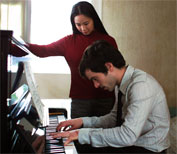
Zizek covers a lot of films and directors: a beaut of a clip from Possessed starring Joan Crawford in which she watches a train slowly pass by, noticing various scenes in each car through their windows, a gorgeous metaphor for watching film; Coppola (The Conversation), Fincher (Fight Club), the Aliens movies, The Matrix (of course! like catnip to philosophers--r.i.p. Jean Baudrillard, who I read somewhere wasn't a fan), The Wizard of Oz, the Marx Brothers, Charlie Chaplin (several clips that shamed me into admitting to myself that it's time I really carefully watched his classics), Ingmar Bergman's Persona, Michael Haneke's The Piano Teacher, Tarkovsky's Solaris and Stalker and more. But he gives probably his most sustained attention to David Lynch (Blue Velvet, Lost Highway, and Mullholland Drive), and Alfred Hitchcock (esp. The Birds, Vertigo and Psycho, plus the recurring image of people hanging on ledges throughout AH's films). In fact, his commentary on Psycho and The Birds, two movies I've never really connected deeply with before, really helped enrich them as experiences for me. And I couldn't believe I'd never picked up on the recurring father theme he found in Lynch. Perhaps that's because Lynch has so many recurring motifs, and the father theme has never really spoken much to me. (I'd love to know what he thought of Inland Empire.)

I think of The Pervert's Guide To Cinema as a creative essay more than a lecture. I wouldn't recommend it to someone looking for facts or history or something concrete. The strength of it is that Zizek is sharing some ideas and a way of seeing that doesn't boil down to a summary, even to that 3-part synopsis from his web site. Still, at times his insights into individual films are so clear and smart that they seem obvious, and I wondered, "Why didn't I ever think of that? How have I never seen that before?" That's a sign of a great critic. He also has a gift for excerpting the most essential moments from films, and at times I did wonder how much of my response I owed to him and how much to the individual filmmakers. Some of his notions, however, are ridiculous, even disgusting (the cinematic screen as overflowing toilet bowl?), and occasionally I found myself wondering to what extent he was joking.

Ideally, I think the film is best watched over three nights rather than in one mad rush the way I saw it, and it is available as a Region 0 import, which surprised me given all the clearances I imagine it required. The film's web site also offers further readings.

Here are the essays he wrote for In These Times on 24, The Matrix, and The Passion of the Christ.

He has also comments on the new, just-released dvd of Children of Men.

An interview with Believer Magazine.

Lastly, he has also has written eloquently about torture recently for the New York Times and the Guardian.

Labels: ,

Sunday, July 30, 2006

Hôtel des Amériques, Psycho, Lady in the Water

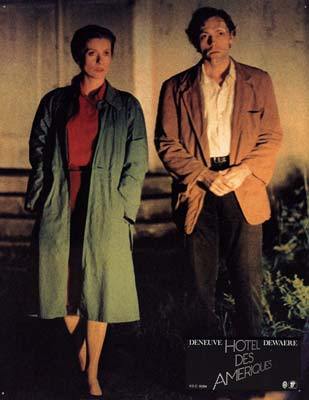
We're getting treated to a Techiné retrospective in Chicago just in time for the release of his new film, Changing Times. I caught Hôtel des Amériques, a 1981 film made 4 years before Rendex-Vous, which was previously the earliest film I'd seen by Techiné. Hôtel stars Catherine Deneuve who meets Patrick Dewaere in Biarritz--by nearly running him over with her car. She's an anesthetist, which I fear is probably a metaphorical choice the meanings of which I'm not interested in sniffing out because they're too obvious. More importantly, this drama uses a handful of major and secondary characters to illustrate the idea that love is a fragile, difficult thing and by no means something we are guaranteed. Certainly not news to most of us, but it's a rare enough truth at the movies, and it's interesting how, filtered through Techiné's romantic sensibility, it's almost as sentimental a notion as the standard ideal that there's one perfect match for all of us who we're destined to find. Techiné explores some trademark concerns about sexuality, as if suggesting the idea that we're like pieces from different puzzles thrown together. Étienne Chicot (who turns out to be in this year's Da Vinci Code, looking, I'm sorry to say, all of his 20 years older) plays Dewarer's drifter musician buddy, and he's got eyes for the ladies but offers from a gent, and there's some ambiguity about what he wants and what he's tempted to try. There's an interesting patch of dialogue about Biarritz as a strange no-man's land, neither Paris nor rural France, which seems like another quintessential theme of the director's. The title clearly has to do with the family hotel changing styles from French to American, but since it isn't an American making those changes, I'm not exactly sure what ramifications were intended. And the film isn't always as compelling as it could be. There was some slightly heavy handed material that he flashed at us quickly--he hadn't quite gotten his editing down to the fluid perfection of the mid-90s work. Rating: 2 ½ out of 4 stars.
I saw Psycho for the first time all the way through, and I really don't know what to say about it. It's difficult to have a spontaneous reaction to a film that's so legendary (I was just looking at some online discussion of Citizen Kane that shows I'm not the only one with that problem). I realize how bold he was in the Janet Leigh plotline, which was surprisingly effective, but I knew too much about the film's twists to give it a completely fair viewing. It's not ever going to be my favorite Hitchcock film, but I liked it more than I thought I would. The score is exceptional, of course. Hitch was at his creative peak. I think it's a shame that Anthony Perkins' career was more or less destroyed by it. I thought he was charming and handsome at times here, and he could have done so much more than cheap Psycho sequels. Rating: 4 out of 4 stars.

I'm so disappointed about Lady in the Water. I've had a blast at every M. Night film up until now, so I couldn't trust the negative reviews. I know there were problems with Signs and The Village (both of which strained credulity, even for this genre), but I enjoyed them. But Lady has forced me off the Shyamalan bandwagon at last. A stupid story (which he apparently made up for his kids) that cheats like the worst whodunit mystery you've ever seen, breaking its own rules in order to try to surprise you. He packs the story with more "quirky" characters than you can bear. Worse, the director's ego clearly needs to be checked. He has a film critic character that he heaps abuse upon, which only makes him look small since his apparent criticisms of film criticism are populist but stupid, and he casts himself as a man who is going to save the world with the story he tells. If that's how he sees himself, it's appalling. If it isn't, he should have known better than inviting people to think so. Made me appreciate the joke Hitchcock played when he cast himself--the director pulling the strings appears in the most trivial moments of the film. Worse still, he's badmouthed Disney, which stuck with him through some bad times, all over the press. I'm thoroughly disgusted.

Still, the cast is first rate--I still think Paul Giamatti is a terrific actor, and he is first-rate here. He does some intense emoting to bolster the story's weaknesses but somehow always made it feel sincere. Bryce Dallas Howard, a revelation in The Village is fine here but is basically stuck playing the damsel-in-distress. They're joined by an obscenely gifted supporting cast of quirky actors, squandered in small roles: Jeffrey Wright, Bob Balaban, Bill Irwin, Mary Beth Hurt, Jared Harris, and Tovah Feldshuh. Any of them could lead a film. I was impressed with Sarita Choudhury, who I'd never seen before. Noah Gray-Cabey was enjoyable enough as a weird tyke. Top that off with cinematography by the film treasure Christopher Doyle and score by James Newton Howard, and somehow the film is watchable. I hope they were compensated, because they'll collectively save Shyamalan's ass. I'd like to see him create one scene of power that doesn't rely on Howard's score for chills. Is he capable any more? I hope he bounces back, but it's time for friends and family (or mentors--Spielberg?) to start giving him the cold truth. You're not a prophet, Night, and these days you're barely an entertaining storyteller. Get it together. Rating: 1 out of 4 stars.

Labels: ,

Monday, January 02, 2006


My Favorite Movies of 2005


2005 was a great year for good movies, but only a good year for great movies. Lower attendance in theaters was endlessly discussed this year, chalked up to DVD competition, cellphone annoyances and lower quality fare, but a convincing study puts the blame simply on higher ticket prices. In other trends, documentaries are crowding out the foreign films, which have no PBS alternative, but many of them have been excellent. Red and I noticed and tired of a strange and disturbing rise of the theme of children in peril, esp. as participants/victims in sexual activity (Mysterious Skin, Palindromes, Innocence, Garcon Stupide, You and Me and Everyone We Know, Keane, Born Into Brothels & Boys of Baraka, The Holy Girl, War of the Worlds). Yuck. War, the cycle of revenge and understanding the terrorist mentality were yet again prominent themes (A History of Violence, Caché, Syriana, Munich, Paradise Now, The War Within). 2005 also saw an uptick in the use of narration, usually ironic yet effective (Kiss Kiss Bang Bang, Happy Endings, Lord of War, Hitchhiker's Guide, Layer Cake). The year also saw an even greater than usual number of Hollywood remakes, a trend which continues full throttle into next year's slate (see #20 on this Film Threat article for a long list).

TOP TEN
1. A History of Violence (New Line Cinema)
A stunningly intelligent thriller about the occasional necessity of using violence as well as the problems that result. The story offers no easy answers or simple polemics. A refreshingly smart and entertaining thriller with excellent lead performances, a subplot of superb counterpoint, and a kind of relevance you rarely get at the cineplex. Compare the two smart and expressive sex scenes, or the two confrontations with the high school bully. Before and after. So economical, yet they say so much. One of Cronenberg's finest.

2. (tie) Grizzly Man (Lions Gate) & The Wild Parrots of Telegraph Hill (Shadow Distribution Inc.)
Two powerful docs that both deal with man's relationship to the animal world. One is horrifying, and the other is romantic and beautiful, like two flip sides of a coin. Herzog maintains his grip on a solid, sensible yet profound view of the world as he journeys into the abyss of a truly foreseeable (yet not necessarily preventable) tragedy. These days, naive dreamers easily become fodder for the big media hate machine, so I appreciated his integrity in handling footage that could have amounted to a snuff film or a punch-line. Judy Irving's documentary is so filled with life and love that it should have been the date movie that the much less intelligent March of the Penguins became. Mark Bittner, as much the subject of this film as his avian acquaintances, shares commentary about the individual birds' behavior that is fascinating, charming, and finally operates on another level of meaning.

4. The Beat That My Heart Skipped (Wellspring)
I haven't seen the original 70s cult classic which this film is based on, but my impression is that this is quite a reinvention. The story seems unlikely--a young man works as a mafia type but nurtures dreams of pursuing a classical music career--but as the film goes on, his character is fleshed out in a psychologically rich way that had me swooning for the film by the end. Like Irreversible (though with far more sophistication and success), it seems to express a fascinating, gendered view of the universe in which maleness itself is pathological, as Thomas dutifully serves his father but feels a powerful pull towards his absent (deceased) mother. Powerful, poetic stuff.

5. Nine Lives (Magnolia Pictures)
Having seen Rodrigo Garcia's previous film, Things You Can Tell Just By Looking at Her, also a collection of loosely linked shorts about women, I never would have expected this film to be so powerful, so excellent. Each scene is filmed in one fluid camera movement, and several episodes (Diana, Samantha, Lorna) would, standing alone, be among the highlights of the year. Even the few (Sonia, Camille) which stray into the pink ribbon politics that marred the earlier effort are grounded in powerful dramatic terms, with fresh angles and superb acting. Fresh, vital, electrifying at its best, Nine Lives presents us a major artist. (And it turns out he's Gabriel García Márquez's son!)

6. (tie) "Mountaineer Spinning" (2004) & "Shining"
No movie I saw this year stunned me (literally) like "Mountaineer Spinning," a 26min. short from underground legend Ken Jacobs. Using a stroboscopic effect and jarring soundtrack to continuously tease and frustrate the eye and the brain, it begins to feel after a few minutes like a futuristic weapon. A young woman in my row began to cry tears of anguish after about 20 minutes. I didn't blame her. It was a kind of torture, like the wrath of an angry god, but it was also profound and cathartic, and I'll never, ever forget it. Shining, a widely seen short posted online, generated the kind of water cooler admiration that few feature-length movies did this year. 25-year-old editor's assistant Robert Ryang entered "a contest...[to t]ake any movie and cut a new trailer for it — but in an entirely different genre. Only the sound and dialogue could be modified, not the visuals...." Ryang transformed horror pic The Shining into Shining, a Miramax-style feel-good dramedy in the vein of As Good As It Gets. In the process, he created the most vibrant work of film criticism of the year. His blast of satire exposes the cliches and manipulations of modern Hollywood with a refreshing anarchy of spirit. He posted his contest-winner online for a couple friends to see, one of them posted it on an obscure blog, and within 10 days an avalanche of traffic ensued and he received a call from the admiring vice-president of a major studio. Comedian Jack Black is also rumored to be an admirer. It may seem silly to choose this short for my top ten, but it had a spark of brilliance that was sorely lacking this year on the big screen. [I also flipped over a New Zealand short called "Two Cars, One Night," a 2003 film nominated for an Oscar in 2005. Michelangelo Antonioni's "Michelangelo Eye to Eye" was also impressive.]

7. (tie) Brokeback Mountain (Focus Features) & Happy Endings (Lions Gate)
I wrestled more with Brokeback Mountain than any other film this year, loving it one day, angry at it the next. It has believability issues, and if it's an argument for gay rights, it's a very conservative one. What saves it for me is that it doesn't feel like a piece of propaganda, even though many are treating it as one. The craftsmanship is remarkable, the performances great (esp. Ledger's), and it's extremely moving. And it has people talking like few films ever do. Happy Endings is in some respects way ahead of the curve for gay storytelling, one in which gay romance is a non-issue and the longing to raise a family is the emotional challenge, though there are plenty of other issues, many of them heterosexual. I was thrilled to see Roos, the director/writer of The Opposite of Sex, back in form, taking us through another story of nasty characters and messy feelings with such great skill that Tom Arnold turns in a surprisingly moving performance.

9. Red Eye (DreamWorks)
I can't feel guilty about the pleasures of this taut thriller, so witty and comic, a B movie with A talent and brains. Probably the most fun I had at the movies this year.

10. Fever Pitch (Twentieth Century Fox)
Too cute for many, but Fallon is surprisingly good as a Red Sox fanatic trying to make it work with a gal (Drew Barrymore) who enjoys his passion but doesn't fully understand the way it works. I know what it's like to be geeky about something, so I fully appreciated this film, the Farrelly Bros.' best film yet.

RUNNERS-UP
11. Oliver Twist (Sony Pictures Entertainment)
12. Keane (Magnolia Pictures)
13. Layer Cake (Sony Pictures Classics)
14. Proof (Miramax Films)
15. Double Dare (Balcony Releasing)
16. Thumbsucker (Sony Pictures Classics)
17. (tie) Harry Potter and the Goblet of Fire (Warner Bros.) &
Sky High (Buena Vista Pictures)
19. Caché (Hidden) (Sony Pictures Classics)
20. Howl's Moving Castle (Buena Vista Pictures)

HONORABLE MENTIONS (the next thirty)
Look at Me (Sony Pictures Classics), Palindromes (Wellspring), Up for Grabs (Laemmle/Zeller Films), Kiss Kiss Bang Bang (Warner Brothers), King Kong (Universal), The Constant Gardener (Focus Features ), Broken Flowers (Focus Features ), The Squid and the Whale (Samuel Goldwyn Films), Lord of War (Lions Gate), Wallace & Gromit in The Curse of the Were-Rabbit (DreamWorks), Corpse Bride, Loggerheads, In the Realms of the Unreal, My Summer of Love, 2046, Walk on Water, The Girl from Monday, Mysterious Skin, Junebug, Me and You and Everyone We Know, Star Wars Episode III: Revenge of the Sith, Batman Begins, In Good Company, Up and Down, Breakfast on Pluto, The Weather Man, Mutual Appreciation, Cinderella Man, The Boys of Baraka, Look Both Ways

AWARDS
Best Actress: Rachel Weisz (Constant Gardner)
Runners-Up: Gwyneth Paltrow (Proof), Naomi Watts (King Kong), Monica Bella (A History of Violence), Lisa Kudrow (Happy Endings)
Best Actor: Damian Lewis (Keane)
Runners-Up: Romain Duris (The Beat That My Heart Skipped), Heath Ledger (Brokeback Mountain), Nathan Lane (The Producers), Robert Downey Jr. (Kiss Kiss Bang Bang)
Best Supporting Actor: Keanu Reeves (Thumbsucker)
Runners-Up: Paul Giamatti (Cinderella Man), Jeffrey Wright (Broken Flowers), Jason Isaacs (Nine Lives), Jack Black (King Kong)
Best Supporting Actress: Robin Wright Penn (Nine Lives)
Runners-Up: Amy Brenneman (Nine Lives), Maggie Gyllenhaal (Happy Endings), Amy Adams (Junebug), Li Gong (2046)

Best Child Performance: Dakota Fanning (War of the Worlds & Nine Lives)
Best Adolescent Performance: Ashton Holmes (A History of Violence)
Best Use of a Star's Persona: Keanu Reeves (Thumbsucker
2005 Christina Ricci "It" Girl Award (breakout ingenue): Rachel McAdams
Best Director: David Cronenberg (A History of Violence)
Best taglines: Joint Custody Blows. (The Squid and the Whale) & There's been a grave misunderstanding. (Corpe Bride) & Something wicked this way hops. (Wallace & Gromit in The Curse of the Were-Rabbit)

Activist Film of the Year: The Boys of Baraka
Most Overrated Film: Crash (despite good intentions) & Flightplan
Most Underrated Film: Proof (And too many films were underseen in '05.)
Best Gay/Queer film: Brokeback Mountain & Happy Endings (though Kiss Kiss Bang Bang, Loggerheads, Walk on Water, Mysterious Skin and Breakfast on Pluto were strong, too)

Best Film Critic: A.O.Scott & Manola Dargis - The Times isn't my favorite source for reviews (except Dave Kehr's DVD column), since they skew towards the "important" over the fun or quirky. Still, the gatekeeper role is tough and thankless. The reviews are ok, but I was fairly impressed this year with the commentaries they write on top of the reviews, esp. a piece Dargis wrote on Brokeback Mountain and a piece Scott wrote asking where all the "howlers" have gone, which probably inspired me more than any other essay or review this year.

2005 Soundtrack Highlights: "Cheer Up! Smile! Nertz!" from Cinderella Man; songs from The Producers and Corpse Bride, a striking moment in Goblet of Fire when Harry returns from an ordeal only to be greeted with cheery brass band music; the interesting song selections in Walk the Line; Diana Reeves' classic song stylings in Good Night and Good Luck; a swiped Pink Floyd song in The Squid and the Whale; Maggie Gyllenhaal as chanteuse in Happy Endings; Elliott Smith and Polyphonic Spree on the Thumbsucker soundtrack; Broken Flowers, another great Jarmusch soundtrack; The Nomi Song; classical and pop music featured in The Beat That My Heart Skipped; a new theme in Star Wars III; silly songs in Hitchhikers' Guide; nerdy Christian family musical group in Palindromes; Jack Kerouac singing “Ain’t We Got Fun” in The Wild Parrots of Telegraph Hill; Breakfast on Pluto soundtrack; and several numbers from Sarah Silverman's Jesus is Magic. In older films I saw this year, I loved Cat Stevens' songs from Harold and Maude; and the waltz as clue in Shadow of a Doubt. Lastly, a new cliche: Middle-Eastern wails used in dark thrillers and dramas, my only real complaint about Layer Cake, but it's turning up everywhere, often jarringly inappropriate.

BEST OLDER FILMS I SAW IN 2005
This was the year I first saw They Live By Night (1949) & Rebel Without a Cause (1955), both by Nicholas Ray. They blew me away, two of the most powerful films I've ever seen, far better than anything new I saw this year. I was also stunned and amazed by Cagney in Angels with Dirty Faces (1938) and Yankee Doodle Dandy (1942). Discovered a new favorite in the wonderful Teresa Wright in Hitchcock's Shadow of a Doubt (1943) and Wyler's Oscar-winner The Best Years of Our Lives (1946). (She acted opposite one of my favorite actors, Dana Andrews, who was never better than in The Ox-Bow Incident (1943), which I also saw this year.) I kept attending art and revival houses in 2005, where I got to see Kubrick's Paths of Glory (1957) and Marilyn Monroe in Don't Bother to Knock (1952), another surprisingly entertaining film, but this was also the year I joined Netflix, the greatest Internet service since Amazon and Google. Life may never be the same. Thanks to the combined wonders of DVD and revival houses, I embarked on a remedial horror series, loving Dawn of the Dead (1978) most, other highlights being Night of the Living Dead (1968) and The Seventh Victim (1943). Hitchcock delivered again in Lifeboat (1944), finally available on DVD. Bloody Sunday (2002) surprised me with its unexpected power. Got my first taste of Harold Lloyd, delightful in Girl Shy (1924) and Safety Last (1923). More Miyazaki was issued in DVD, and I loved Nausicaa of the Valley of the Winds (1984). A fascinating artfilm called Decasia: The State of Decay (2002) impressed me, and Smile Performed by Brian Wilson (2004) gave me much more than a chance to experience a concert tour I missed. Other highlights of the many, many great older films I saw: Douce (1943), My Life as a Dog (1985), Winchester '73 (1950), 3 Women (1977), and The Man with the Movie Camera (1929).

Labels: , ,

Friday, July 01, 2005

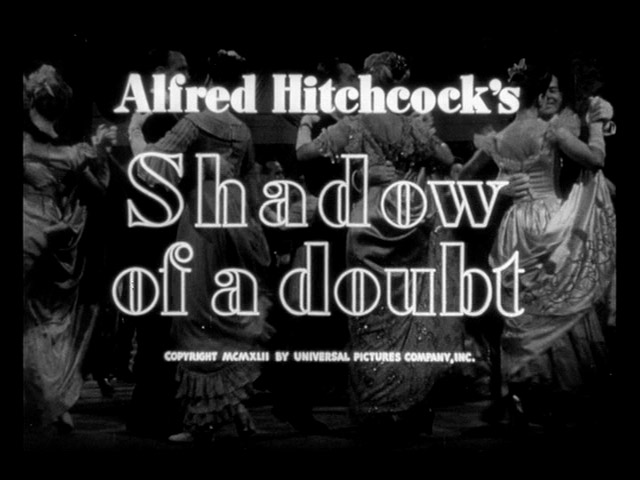
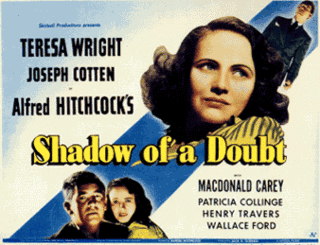
Recently saw Alfred Hitchcock's Shadow of a Doubt (1943) for the first time, one of his most entertaining films. The dialogue is excellent, especially that of the precocious children, unique and often hilarious characters. The film revolves around a young woman named Charlie and the uncle she's named after, a man who we quickly learn is a killer. (Although the film begins with him in early scenes, it quickly becomes her film, dominated by her point of view, not that of the killer, as Truffaut erroneously implies in his classic interviews with Hitchcock.
I find that Truffaut is too often wrong about the details of Hitchcock's films in that book, and Hitchcock usually doesn't correct him, but it must have been easy to become confused is discussing so many films they probably hadn't seen in a while.)

I think what's most fascinating about the film is the way this young heroine decides to deal with her suspicions on her own, without turning to the law (despite ample opportunity) or even her parents. She wants to protect them, and so they become as innocent as the young children. I often find that films made during WWII deal in some way with the great absence of men in their prime years. (You can also feel it in Meet Me in St. Louis, made the year after, partly in the expression of longing for a young man.) Charlie is greatly endangered, yet still prefers to come to an understanding with the killer rather than turn him in and shame the family who, living in an idyllic small California town, are more vulnerable to the effects of reputation.

I love Hitchcock's subversive sense of humor throughout the film, which never comes close to the pitch of The Trouble with Harry but still seems a risky strategy in a story involving the murder of innocents. Charlie's father, played by Henry Travers (Clarence in It's a Wonderful Life) has a running game going with a friend (played by Hume Cronyn) in which, inspired by radio serials, they try to plot the perfect murder. It's a charmingly anti-pretentious touch, drawing attention as it does to the film's own lurid story, though perhaps it's a bit of showing off, because Hitchcock knows he can keep us absorbed despite this threat to the narrative illusion. There are, though, a couple moments that play in a very strained way now, in which the killer mutters his psychotic thoughts but we're asked to believe that only young Charlie understands their significance while the others don't catch on.

Just for the record, the movie also features yet another classic librarian stereotype who comes on stern but then assists the young detective. The film also uses an old waltz in a fascinating way, hypnotic and nostalgic, yet woven into the plot as a subliminal clue. (And here are some more images from the film.)

Rating: 3 1/2 out of 4 stars.

Decent little article on the trend (which I recently blogged about) of books about the film canon. It mentions the Derek Malcolm book, which I have and isn't bad, as well as Ebert's, Rosenbaum's and Turan's recent books, but it omits Flickers by Gilbert Adair, one of the quirkiest and most interesting book of this type.

Song: "Merry Widow Waltz," used in Shadow of A Doubt

Labels: ,

Sunday, November 21, 2004

Short takes: a movie roundup


This time of year the films come fast and furious, and the cineplex swells as the summer&Christmas popcorn crowds rediscover the fun of movies. Meanwhile, the flood of DVD releases continues to yield treasures.

Sideways - Such an exquisitely crafted movie! It's about a wine connoisseur, his romantic prospects, his friendship and his passions, but its true focus is that crisis point when life's ambitions seem to be dying of failure, withering on the vine. As ever, Alexander Payne displays a real gift for putting characters under the microscope. The friendship between Paul Giamatti's down-on-his-luck, Frasier wannabe and Thomas Haden Church's maturity-challenged, third-tier TV actor could merely have been played as a standard Mutt and Jeff routine, but this is something much deeper and subtler. It's one thing to achieve mere mimicry, like Charlize Theron in Monster or Jamie Foxx (this year's Oscar fave) in Ray, but it's another again to create characters from scratch the way Giamatti & co. do here. It's astonishing. During a getting-to-know-you conversation that takes place at the climax of a touch and go date, when Virginia Madsen's Maya shares her thoughts on wine, it's the most magically romantic moment of seduction I've seen in a movie in ages. If the film's material is somewhat familiar overall, it's still polished to perfection. We've no right to expect hopefulness from an Alexander Payne film (and the more biting ending of Election still feels like proof that it remains his best film), but, despite our instinctive distrust of happy endings because they are all too often merely reflexive, this one feels necessary. Rating: 4 out of 4 stars.

The Forgotten - The Mommy Matrix. The mother-child bond is the obsessive focus of this far-out story which will have you asking, Is she insane? or are the writers? Effectively suspenseful--translation: it may make you jump in your seat a lot--and Julianne Moore always shines, but the story is kind of stupid. I was ultimately unsatisfied, because as a puzzle film it's too simple. Rating: 1 out of 4 stars.

Tarnation - Question: Who takes a video camera along when they puke into a toilet? While the family suffering documented here is no doubt real, the cynical side of me can't help suspecting that this film is on some level a stunt to land NY actor Caouette a film acting career. Instant backstory, instant persona. The story is almost as miserable as Capturing the Friedmans, but nowhere near as intelligently made. That film displayed an expert narrative ability (it adds layers delicately, each one showing us more depth of possibility), but this does little more than show off iMovie's graphic capabilities. Rating: 1 out of 4 stars.

The Trouble with Harry (1955) - A droll murder mystery that is at the same time highly abstract (the characters almost exist as on a blank stage, like a Beckett play) and unusually realistic, at least in terms of behavior (characters make plans, then change their minds and undo them, then redo parts of the plan, etc.; they act out of self-interest and other less-heroic motivations). The pace seems a tad slow by today's standards, and some of the acting could be sharper, but I was entertained by its clever playing with murder mystery formula and esp. with conventional murder mystery morality: most of the characters are shockingly unconcerned about the dead man, and a final exculpatory revelation is, intriguingly, anything but. Innocence and guilt are entwined like a trap. With its romance and comedy, the film appears to be giving us what we want, but anyone who falls for that simple reading will find themselves stuck in an amusing finger trap. Once again, Hitchcock produces a double-duty film, one that can merely entertain but that can also challenge as an intellectual work of art. Featuring the film debut of the amazing Shirley MacLaine. Rating: 3 and 1/2 out of 4 stars.

Elena and her Men (1956) - Do you know that Woody Guthrie song written for & about Ingrid Bergman? He wrote the lyrics (including "Ingrid Bergman, let's go make a picture") in 1950 and it was set to music by Billy Bragg and Wilco on Mermaid Avenue a few years ago. Well, Jean Renoir felt the same way about her. In an extra on the new DVD of the film, Renoir explained that the whole purpose of the film was to work with her. Her extraordinary charms are front and center, here. The story is about a Polish princess who, as a kind of hobby, takes an interest in men and, muse-like, sees them reach their potential. Her path crosses with a war hero general, who she (like his legions of fans) wants to see lead the French nation into better days, and this she in ensnared in politics, including the romantic kind. The filmmaking is graceful, colorful and charmingly old-fashioned. One sequence in particular, in which Elena and hundreds of others, are jostled around in a crowd to witness the spectacle of General Rollan in a parade, is especially magical, a comical cartoon of mix-ups put right again. By the end, an earthy gypsy woman is put forth as kind of foil to Bergman's character and there are ugly hints of trapping this free spirit through deception, and the ending sours what should have been a light, happy ending. It's as if the celebration of Bergman's magic has become threatening and her character must be punished. Alas, too much of the film falls flat, anyway, but it's so close to achieving the cinematic equivalent of champagne. Very disappointing. Some interesting scenes that evoke community as character, a French spin on the old Greek chorus and at times an almost Shakespearean style of comedy. Rating: 2 out of 4 stars.

Labels: ,

Saturday, November 06, 2004

The Awful Truth about Screwball and Film Noir


Saw an old screwball classic today, The Awful Truth, starring Cary Grant and Irene Dunne, and it's one of the best, funniest screwballs I've seen yet (out of the dozen or so I've seen so far). I realized there are different screwball formulas. My favorite screwball of all time, Bringing Up Baby, like the 70s neo-screwball comedy What's Up, Doc? which draws inspiration from it and other classic screwballs, has a nutty, smitten woman chasing an uptight man until wild circumstances allow him to let his guard down and see that he loves her, too. The formula of The Awful Truth, on the other hand, like that of Mr. and Mrs. Smith, the Hitchcock film I wrote about recently, is this: a married couple become unmarried after a superficial spat and then, in an attempt to deny their continued feelings of love, proceed to sabotage each other's subsequent affairs. It seems there are never children in a screwball, but there are often animals, both domestic and wild. Funny that Mr. and Mrs. Smith should come up, since, by coincidence, in The Awful Truth there's an adorable and hilarious pet dog named Mr. Smith (who, I'm told, was a star in his day--certainly a great talent and a scene stealer). My biggest problem with the Hitchcock picture was that it got too spiteful and mean, so that you couldn't root for the couple to get back together. You might feel they deserved each other, but the film's sense of romance gets shot by the end. Not so in the vastly superior The Awful Truth, which, through a deft combination of direction and acting, gets just the right recipe: great handfuls of comedy, a dash of strong wistfulness, and a consistent flavor of romance.

Then there's the nutty ensemble screwball, such as many of Preston Sturges' films. Recently, I was absolutely bowled over by a stunningly good film, I ? Huckabees. It's one of the few successful neo-screwballs of the last several years (artistically, at least--the box office has been meager so far, though it's only been in limited release). I'd classify it in the crazy ensemble screwball formula, but it's so much more original than that makes it sound. While there are romantic elements, the film is ultimately about philosophy, about the big questions of life and how we cope with the crises of modern life, yet rather than coming off as pretentious, the film somehow feels very relevant. Imagine: a firefighter who's reexamining his life post-9/11, played by Mark Wahlberg (in perhaps the film's most surprisingly impressive performance). Except you won't notice its profundity or its relevance because you'll be too busy laughing.

It's perhaps my favorite film of the year.

Lately I've been thinking how much more I like screwball comedy than film noir. I've been part of a movie discussion group, and this year we watched 10 or so examples of film noir, most recently Out of the Past. Because many of us had already seen them before, we tended not to watch the best, most famous noirs, but we still chose highly regarded and well-reviewed titles. As time went on, it became clear that they all tend to be pretty much the same, with crazy MacGuffin plots that keep your brain scrambled but never add up. Only a very few film noirs have ever really impressed me (Gilda, for example, or to some extent Laura), but I've had a better average finding great screwballs. Plus, great screwballs tend to be exhilarating and romantic; film noir tends to leave one in a cynicial mood.

Critic Jonathan Rosenbaum recently put it best:
"Is there any way to win?" asks Kathie Moffat (Jane Greer), archetypal doom-ridden noir heroine in Out of the Past (1947), addressing Jeff Bailey (Robert Mitchum), archetypal doom-ridden noir hero. He replies, "There's a way to lose more slowly." When it comes to politics in art, the mannerist noir style seems to be one of the most attractive ways of losing slowly. It makes doom more voluptuous and artful than success, makes a film's characters seem "half in love with easeful Death," as Keats put it. I often wonder if the fondness many leftists have for noir films stems from their being suckers for romantic fatalism -- defeatists who wouldn't know what to do with success if it hit them over the head.
Out of the Past is sumptuously made, with excellent performances, exquisite cinematography and some of the sharpest one-liners in the genre (like, "Joe couldn't find a prayer in the Bible"), but after seeing it twice it still doesn't quite satisfy me the way it should.


Labels: , ,

Thursday, September 30, 2004

Film Round-up:
a review of The Five Obstructions, The Village, Intimate Strangers, Mr. and Mrs. Smith, Shaolin Soccer, and Hero


What with the Chicago International Film Festival coming up, not to mention a big fall movie season, I want to wrap up a bunch of movies I've seen in the last couple months. Out with the old, in with the new.

The Five Obstructions
The Five Obstructions is a curio for cinephiles, a kind of game played out over many months between Lars von Trier and Jørgen Leth, one that reminded me of the kinds of parlor games played by European surrealists, or the kinds of assignments commonly given in writing classes. Leth is to remake his classic short film, "The Perfect Human" (an experimental gem which, frustratingly, we never get to see in its entirety), and von Trier is to set rules each time to make Leth's task more difficult. Of course, limitations famously cause artists to draw on new levels of creativity (von Trier, after seeing the first film, admits, "I see I gave you a gift" instead of a barrier) and there's some fun here in seeing Leth play with the rules, often interpreting them in ways that suit him. The short films he produces are somewhat interesting, and the project raises interesting issues about authorship (von Trier writes and directs the final installment but attributes it to Leth), ethics (one short is a film of Leth dining elegantly in the middle of an impoverished Indian neighborhood), and creativity, but the most successful short here is animated by Bob Sabiston, the genius who worked on the great Waking Life. The Five Obstructions may, however, be most useful for providing insight into von Trier's simplistic philosophy of cinema, which involves provocation through punishment: of his characters and of his audience. Here he poses as if he's punishing his friend, but it's pretty clear he has participated in this game at least partly to help a friend pull out of a funk, which, aside from being a nice thing to do, suggested to me that his anti-humanist style is one he emplys simply for show. Underneath it all, his filmmaking is empty, nihilist, something to pass the time. Rating: 2 and a half stars out of 4

The Village
Well, what can I say? I'm a Shyamalan fan. The twists get people worked up and hog all the attention in the reviews, but his work is consistently unique, fresh, and fascinating. He seems to approach film with his full creativity, his highest goals being to surprise and entertain us. What's wrong with that? He may not be the most intellectual man ever to direct films (Signs is supremely stupid when looked at from some angles), and his take the Hitchcock imitation too far (giving himself cameos), but, then again, he seems unusually willing to address big questions. The Village had me guessing outrageous scenarios in my mind--at one point I thought, Maybe they're on another planet!--but he sprinkles in enough clues that, for once, I was able to guess the twist a little before it was fully revealed. Bryce Dallas Howard is extraordinary as a young blind woman--what a find! (I'm so glad I didn't know who she is when I saw the film, so I won't tell you.) The rest of the cast varies, and I question many of the writer-director's little touches here and there, but overall it's certainly worth seeing. People are speculating that his next project will be an occasion for change in his work, since he's directing someone else's story, the prizewinning Life of Pi, but there's a killer twist to that book, too. It's actually a perfect fit, without asking MNS to change or grow much at all. Rating: 2 and a half stars out of 4.

Intimate Strangers
How's this for a juicy premise: a woman, heading for her first therapy appointment, walks into the wrong office (that of an accountant) and starts spilling her guts. He says nothing, used to clients getting stuff off of their chests, but then is so drawn in that he fails to tell her he's not a psychologist. Juicy, right? Too bad the rest of the movie sucked beyond belief. What a dull disappointment. Rating: Half a star out of 4.

Mr. and Mrs. Smith
Part of a beautiful recent package of Hitchcock films, Mr. and Mrs. Smith is completely different from what you expect of a Hitchcock film. It's an old-fashioned screwball comedy, and guess what? It ain't half bad. Featuring that queen of screwball comedy, Carole Lombard, playing opposite Robert Montgomery, the story plays with the idea of a well-established, happy, marriage that is suddenly discovered to be illegitimate due to a legal technicality. The chemistry is wonderful, mostly due to Lombard's zany charm, but for my taste the story gets a little too mean, takes its own silly premise just a few steps too far. Rating: 2 and a half stars out of 4

Shaolin Soccer
This quirky Hong Kong film was championed by critics while it languihsed in Miramax's famously overcrowded vault of acquisitions, but I didn't see the reason for the fuss. Articles about the DVD release, though, which includes more footage, suggest it also suffered (when finally released) in Miramax's equally infamous editing room. Still, I can only review what I saw, which was a lame narrative of oddball superhuman soccer. The bad soundtrack and perplexing romance are probably Miramax's fault, but the film's special effects are cheesy and ugly, the kind of low-rent visuals you get in the Spy Kids movies. And, I'm not sure, but I think I detected an ugly whiff of anti-Korean nationalism in the mix. The basic story idea (a bunch of lovable losers have to pull together as a team) had potential, but the film never got me to care. Rating: Zero stars out of 4.

Hero
I enjoyed Hero, but I much prefer the more comic book-like Crouching Tiger. Hero is getting praised left and right for its stunning visuals, but what it comes down to is a simple design of strongly accenting one or two colors at a time, which strikes me as actually a little dull, like a children's let's-learn-colors book. The story structure is elegantly simple, a single conversation that flashes back to some action that is revised in version after version (yes, a bit like Roshomon). Tony Leung and Maggie Cheung are beautiful actors, and it's great to see them re-teamed after the exquisite In the Mood for Love, but the casting of these Hong Kong actors only underscores the troubling Chinese imperialist themes of the script. They play assassins assigned to kill a warlord bent on unifying the various factions of ancient China to create one great nation, and the script clearly sides with the cause of unification. No wonder this officially sanctioned film was so lavishly budgeted. Underneath the samurai swords and colorful robes, the film boils down to propaganda, plain and simple, a message that undermines democracy in Hong Kong, and I find it bitterly ironic that this film draws on Hong King cinematic traditions to convey that message. Rating: 2 stars out of 4.

Labels: ,